Calculate your pay, track your hours, understand your rights, and navigate California's social services — all in one place. Built by someone who lives it.
IHSS paperwork is confusing. We built a tool that makes the numbers simple and trustworthy — so you can focus on the care.
Verified against real IHSS earnings statements across 36 pay periods and counting — every partial week, every OT scenario, every minute.
Every California county sets its own IHSS hourly rate. Enter yours directly into the Personalization Wizard — find it by calling your county office or looking it up through CDSS.
Understand how to read and complete your IHSS timesheet correctly, and avoid common errors.
We explain IHSS rules and processes in clear, simple language — no legal jargon.
Know exactly how many hours you've used and what's left in your authorization period.
Designed with real IHSS providers and recipients in mind. No bureaucratic complexity — just clarity.
IHSS Unlocked is a planning tool — not a log. Use it to maximize your recipient's authorized hours, maintain consistency, and stay clear of violations every pay period.
Your authorized hours, your county's pay rate, your recipient's situation — the Wizard is built around your specific case, not a generic template.
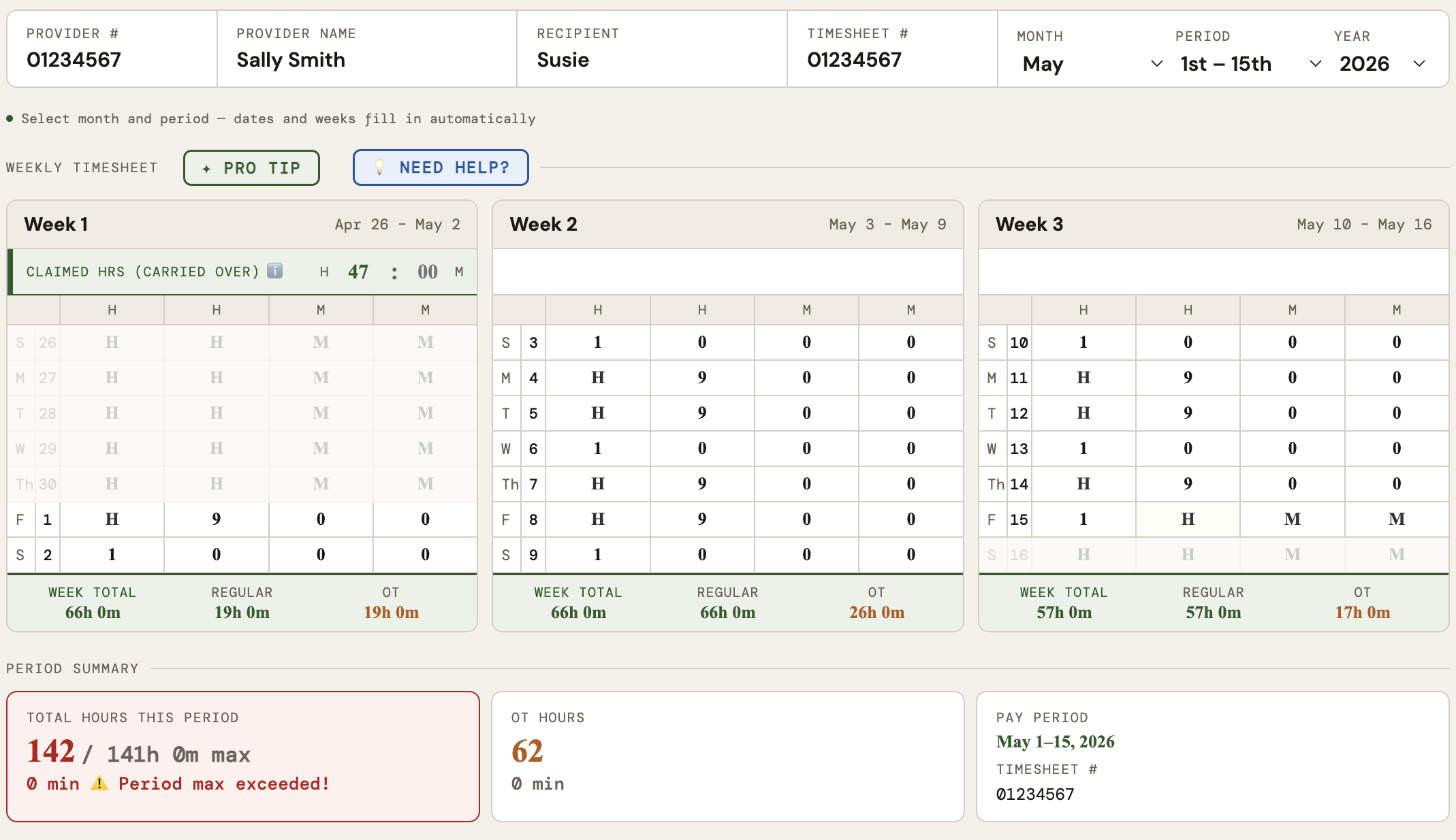
The calculator works by pay period, not the full month. Map out your daily hours in advance to make sure your recipient's authorized hours are fully and consistently utilized.
As you plan, your pay and hours adjust instantly. Any potential violations are flagged before they happen — so you can adjust your plan, not your timesheet after the fact.
Print or save your planned schedule for your records. Walk into every pay period with a clear, consistent plan that protects both you and your recipient.
The tools California IHSS providers and families actually need — in one place.
Clear, plain-language guides to help you understand the IHSS program — from eligibility to timesheets.
Learn what the In-Home Supportive Services program is, who it helps, and how it works in California.
Step-by-step walkthrough of the IHSS application process, what to expect, and how to prepare.
An IHSS service for recipients who need constant supervision due to a cognitive impairment. Learn how it works, who qualifies, and how to document the need.
Electronic Visit Verification is required for non-live-in providers. Understand the rules, the Home vs. Community choice, and how to avoid flagging your case.
How to read, complete, and submit your IHSS timesheet correctly — and avoid common errors.
IHSS rules, wage rates, and contacts vary by county. Find the information for your area.
Plan your entire pay period. Flag potential violations before they happen. Know what your check will be.
Planning with guardrails.
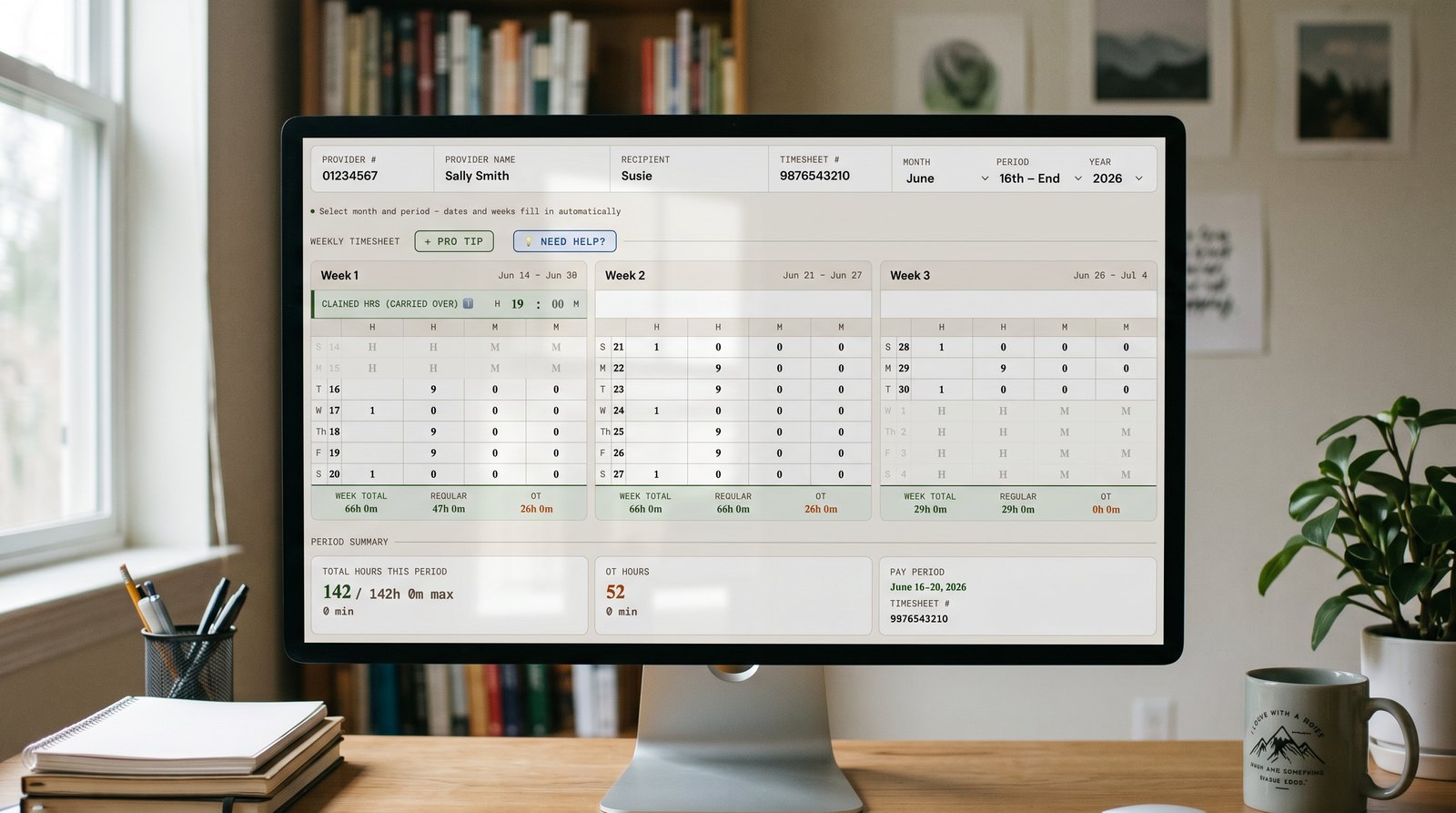
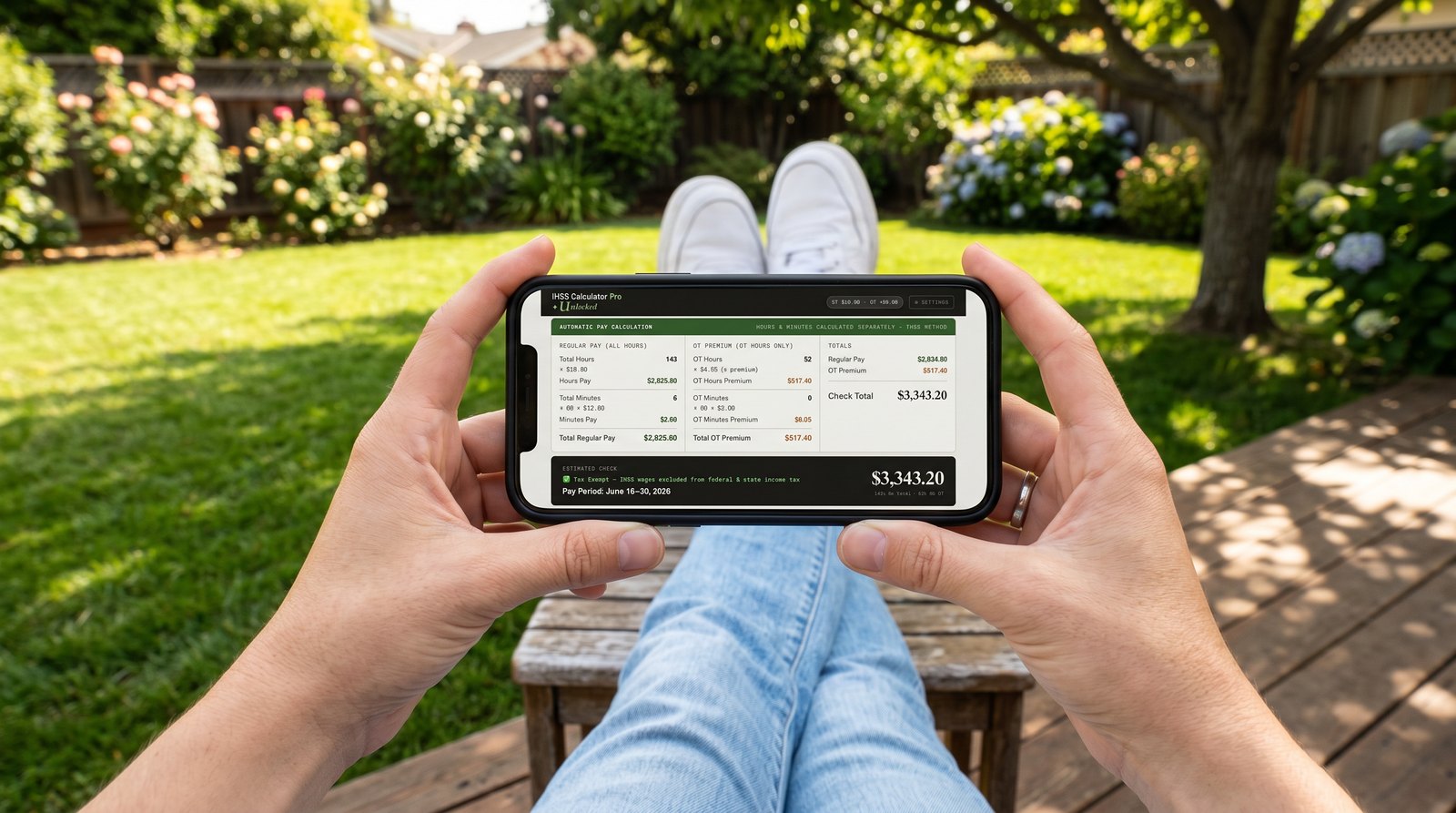
IHSS Calculator Pro is a professional-grade pay period planning tool that shows you the whole pay period before it starts. Progress through the Wizard to set up your specific situation, then lay out your authorized hours across workweeks, see potential violations flagged in real time, and watch your paycheck update as you work through your plan.
Curious what makes this a better solution for your situation? See our FAQ →
Already a member? Log in here · Manage your Subscription
If you're navigating IHSS, there are likely other programs your family qualifies for. Here's what you need to know.
Tax-advantaged savings for people with disabilities. As of 2026, save up to $20K/year without affecting SSI or Medi-Cal, and eligibility just expanded to millions more. One of the most underused benefits available.
Federal income support for people with disabilities or limited income. Understand eligibility, payment amounts, and how it coordinates with IHSS.
California's food assistance program (formerly food stamps). Many IHSS recipients and providers qualify. Learn how to apply and what to expect.
Protect your loved one's government benefits while still providing financial support. Critical planning that too many families discover too late.
California's Medicaid program covers most IHSS recipients. Understand your coverage, how to maintain eligibility, and what's included.
Estate planning for families caring for someone with a disability. Understand how living trusts work and why they matter for your family's future.
Answers to the most common questions about IHSS and how to use the planner.
Overtime is not automatically available to every IHSS provider. Whether you qualify depends on your recipient's authorized monthly hours.
Single-recipient providers. Overtime is authorized when your recipient's NOA exceeds 160 monthly authorized hours, which works out to more than 40 hours per week on average. If your recipient is authorized 160 hours or less per month, working over 40 hours in any single week is a violation, not just unpaid overtime. The county must pre-approve any week over 40 hours for these providers.
Providers caring for two or more recipients. When you care for two or more IHSS recipients, your combined hours across all recipients are capped at 66 hours per week. Overtime is authorized on combined hours between 40 and 66 hours per week. Each recipient's authorized monthly hours are tracked separately, but the 66-hour weekly cap applies to your total work across all recipients.
Rare exemptions exist that raise the cap to 90 hours per week, but they require county approval and are granted only in specific circumstances. Contact your county IHSS office if you think your situation may qualify.
The takeaway: know your authorized monthly hours and what they mean for your weekly limit before you plan your pay period.
IHSS overtime kicks in after 40 hours in a single work week (Sunday through Saturday). Unlike most California workers, the daily overtime threshold does not apply to IHSS providers. It's weekly only.
There are also two things about IHSS pay calculation that surprise most people:
Hours and minutes are calculated separately. IHSS does not convert time to a decimal. Your hours and your minutes are each multiplied by your pay rate independently, then added together.
Overtime is a premium, not traditional time and a half. You get paid your full base rate for all hours worked, including overtime hours. Then an additional half-rate premium is added on top for the overtime hours only. The result is the same as time and a half, just calculated the IHSS way. The end result is still the same as traditional time and a half. This is just how IHSS breaks down the calculation.
Let's look at an example:
In this example, we'll use the current statewide maximum of 283 authorized hours per month for a single recipient with protective supervision. To spread that over two pay periods, you divide by 2. That comes out to 141 hours and 30 minutes per pay period. You can also split it 141 and 142 to keep the math simple.
If the provider used all 141 hours, regular pay is calculated like this: 141 hours x $18.90 = $2,664.90.
Since you were paid your regular rate for all 141 hours, the overtime premium rate is half of your base rate. At $18.90, that premium is $9.45.
If you worked 47 overtime hours for the entire pay period, your overtime premium pay would be $444.15. Your total paycheck for a tax-exempt provider would be $3,109.05.
Although IHSS calculates overtime differently than most employers, the end result is exactly the same. In the traditional method, you would be paid $18.90 for 94 regular hours of work. For the 47 hours of overtime, you would be paid time and a half, or $28.35. So 94 × $18.90 = $1,776.60 and 47 × $28.35 = $1,332.45. Total pay, regular and overtime, is the exact same as the IHSS way: $3,109.05.
Free IHSS calculators are not planning tools. Period. You're letting a number generator randomly dictate what hours you claim in the IHSS portal. It's stated right in the name: "Create My Timesheet." It's creating your timesheet. You're not planning it yourself. In IHSS, you don't create a timesheet. You plan your pay period. You report the hours you actually worked.
When we started building IHSS Unlocked, the question came up directly: should the tool generate daily hours for the user? The answer was an emphatic no. Because generating daily hours isn't planning. You plan your own days with your recipient, and the Unlocked planner helps you cover every day of the pay period while maximizing every minute of your recipient's authorized time.
That design choice wasn't arbitrary. CDSS itself instructs providers and recipients to spread hours throughout the month. From ACL 16-01:
"...the recipient will need to allocate his/her authorized monthly hours throughout the month to ensure he/she has enough hours to cover his/her authorized services until the end of the month."
"[Recipient] will budget all of her hours regardless of the number of days in the month to ensure complete coverage of her authorized hours and services throughout the month."
The state repeats this language in forms providers and recipients sign at enrollment:
Spreading hours throughout the month is the default expectation. When circumstances require a different distribution, ACL 16-22 permits the provider to adjust the workweek schedule, but only if fewer hours are worked in another week to balance it out, and only if the adjustment doesn't generate more overtime than the original plan would have.
Spreading hours evenly is the default. Adjust deliberately when needed. That's what the state expects. A tool that builds lopsided pay periods, stacks long days back-to-back, or drops random zero-hour days is working against that framework, not with it.
IHSS Unlocked is a professional-grade pay period planning platform. It respects the actual structure of IHSS: the two pay periods per month, the workweek rules defined in ACL 16-01, the three most common violation types, the carryover hours from the prior pay period, and the exempt and non-exempt overtime rules.
On top of all that, it calculates actual paychecks for exempt providers and gross pay for non-exempt providers. When gas and groceries are expensive, it's important that your planner does both.
You have the right to request a State Hearing if your hours are reduced or eliminated. You must file within 90 days of receiving the notice, but the timing of when you file matters enormously.
The critical window: you must file your appeal before the effective date shown on your NOA. The county is required to send the NOA at least 10 days before that date, so act as soon as you receive it. If you request your hearing before the cut takes effect, you may qualify for Aid Paid Pending (APP), meaning your current hours stay in place while your appeal is being decided. This protection is only available if you act before the reduction kicks in.
If you miss that window, you can still appeal within the 90-day period, but your hours will drop while you wait for your hearing, and that wait can take months. If you find yourself in that situation without an advocate or attorney, it may be worth consulting one. An IHSS specialist or disability rights attorney can help you build a stronger case and navigate the process more effectively.
Disability Rights California has a full guide on IHSS disagreements and the appeal process →
You can try, but you'll get a confident answer that's wrong in ways you won't catch until your check doesn't match. IHSS overtime isn't calculated like regular overtime. The work week runs Sunday through Saturday, not by pay period. Claimed hours from the prior period affect your weekly cap. Minutes are calculated separately from hours. County wage rates change. The 66-hour rule for two-recipient providers has its own exemption logic.
ChatGPT doesn't know your county rate, your authorized hours, or which pay period you're in. Google will send you to a forum post from 2019. Neither one will flag a violation before it happens. With IHSS, you're certain to get one.
This calculator was built by a family that has been navigating IHSS since 2007 and verified against 50 real pay periods before launch. It's not general information. It's a tool built specifically for this.
IHSS Unlocked wasn't built in a boardroom. It was built by a family who has navigated every corner of California's special needs system, and wanted to make it easier for yours.
My special needs journey began in May of 2007, the month I met my future wife and her beautiful 13-month-old daughter. Two years later, she was diagnosed with autism. That diagnosis didn't just change our lives; it launched us headfirst into a complex world most families aren't prepared for.

What followed was years of navigating systems that weren't designed to be navigated easily. Special day classes. IEP meetings. Service denials. ABA therapy, speech and language therapy, occupational therapy. We became regulars at SEEPAC (the Support, Education, and Empowerment for Parents of Autistic Children meetings at CHOC Hospital in Orange County). We showed up every week and learned everything we could.
I took it further and dove into a first responder training program teaching law enforcement and emergency personnel how to recognize autism, understand the challenges families face, and interact safely in already stressful situations, identifying triggers like flashing lights, loud noises, and elopement behaviors.
Over the years we retained attorneys for our living trust, a specialized attorney for our daughter's special needs trust, another to navigate conservatorship when she turned 18, and yet another who specialized in helping families like ours through the SSI application process, which as many of you know, is often denied the first time. That same attorney helped us obtain IHSS.
IHSS has been invaluable to our family. It has given us opportunities we couldn't have managed alone, providing consistent, quality care for our daughter while maintaining our own lives. But the system itself? The calculations, the rules, the timesheets, the overtime limits? Confusing doesn't begin to cover it.
That's why this site exists. Not because we saw a market opportunity, but because we lived the confusion, and we want every family behind us to have an easier path.
Why we built the calculator
For years, I managed our IHSS hours and pay the hard way: a homemade form I designed myself, printed out, filled in by hand, ran the calculations manually, and filed away every pay period. It worked, but it was tedious, error-prone, and time-consuming. There had to be a better way.
After going through the IHSS process ourselves, we were shocked to find there was no professional tool for providers and families to calculate pay, track hours, and avoid violations. What existed was either a basic county spreadsheet or nothing at all.
So we built what we wished existed: a professional-grade calculator that handles real-world IHSS complexity: dual recipients, overtime, weekly limits, and period maximums. All in one place, for every California family that needs it.
Have feedback or a question? We genuinely want to hear from you. This platform grows when our community tells us what they need.
Plan your pay period. Calculate your paycheck.
A quick review of the essentials to get the most out of your IHSS plan.
IHSS takes violations seriously. Learn about the 4 official violation types and the February timesheet pitfall — straight from CDSS.
40 hours of paid sick leave per year. Here's how to actually use it.
New to the calculator? Walk through setup, the wizard, and planning your pay period.
Plan your pay period, flag violations before they happen, and know your paycheck to the penny. Built by a provider family.
CDSS issues violations when timesheet entries trigger one of four specific rules. Understanding the 4 violation types is the first step to protecting yourself and your recipient.
All four violation training videos are published by the California Department of Social Services.
View CDSS Violation Training Videos →Occurs when a provider claims more overtime hours in a workweek than the recipient's authorized weekly maximum allows. This is one of the most common violations — often triggered by trying to make up hours from a prior week.
Occurs when a provider claims more overtime hours in a calendar month than the recipient is authorized. Short months like February are especially dangerous — with only 4 workweeks and zero buffer, there is no room for carry-over from the prior month.
Applies to providers who work for two or more recipients. The combined total hours across all recipients cannot exceed 66 hours in any single workweek, regardless of each recipient's individual authorization.
Occurs when a provider claims more than 7 hours of travel time per workweek when traveling between multiple recipients. Note: This violation does not apply to most single-recipient providers.
February is the most dangerous month for IHSS providers. With only 28 days and exactly 4 workweeks, there is no buffer week to absorb any missed or carried hours from January. CDSS strongly recommends using a calendar to plan your schedule every February. Providers with 283 authorized hours must hit their exact weekly maximum every single week — one missed day and those hours are gone permanently.
View CDSS February Timesheet Tips (PDF) →IHSS violations escalate. Understanding each level — and the rights you have at every step — is how you protect yourself and your recipient.
Per the CDSS Training Academy, a violation is issued when a provider does any of the following:
The consequences escalate with each occurrence, up to a 1-year termination from the IHSS program.
Terminated providers must complete all enrollment requirements again to return after the 1-year ban.
When you receive your 2nd violation notice, it arrives with CDSS self-certification training materials. If you review the materials and submit the verification notice within 14 calendar days of the notice date, the 2nd violation is removed from your IHSS record.
Miss the 14-day window and the 2nd violation stays on your record. This training can only be used once — it cannot remove any future violation.
If you disagree with a violation, you have 10 calendar days from the notice date to request a county review. You request the review by submitting the SOC 2272 — Notice to Provider of Right to Dispute Violation for Exceeding Workweek and/or Travel Time Limits.
Once the county receives your SOC 2272, it has 10 business days to review, investigate, and send you a decision.
For 3rd and 4th violations only: if the county upholds the violation, you can request a state-level review by CDSS within 10 business days of the county decision. The county notice will include instructions on how to request the state review.
If multiple errors happen in the same calendar month, only one violation is issued. The second error is tracked but does not count as a separate violation.
View CDSS source →Violations caused by scanning errors or timesheets processed out of order can be overridden by the county during the dispute review process.
View CDSS source →Each violation-free year drops one violation from your record. If you go a full year without a new violation, your count is reduced by one. Each additional violation-free year reduces it again.
After a 4th-violation termination, you serve the one-year ineligibility period. To return to the IHSS program after the year is up, you must re-enroll completely:
Once you're re-enrolled, your violation count resets to zero.
Violations are avoidable. Every one of the four triggers above comes from the same root cause — submitting a timesheet that exceeds your workweek or travel limits. The Calculator was built so you plan your pay period before that timesheet ever gets submitted.
A complete walkthrough of the IHSS Unlocked calculator — from first-time setup to planning your pay period with confidence.
Completing your plan in the IHSS Unlocked calculator does not submit anything to IHSS. This is a planning and estimation tool only.
Once your plan is complete, save or print it — then enter your hours in the official IHSS Electronic Services Portal (ESP) at etimesheets.ihss.ca.gov, or by phone through the Telephone Timesheet System (TTS) at (833) 342-5388. Your timesheet is not submitted — and you will not be paid — until it is entered and approved in the official IHSS system.
The IHSS Unlocked calculator is a planning tool — not a day-by-day entry log. Use it before your pay period begins to map out your hours, maximize your recipient's authorized hours, maintain consistency, and stay clear of violations. Pre-planning your schedule is responsible caregiving — it ensures your recipient receives the full benefit of the hours the state authorized for them.
| Term | What it means |
|---|---|
| Authorized Hours | Monthly hours approved by your county social worker. Found on your NOA. Maximum is 283 hours/month. |
| Pay Period | IHSS divides each month into two periods: the 1st–15th and the 16th through the end of the month. |
| Work Week | For IHSS overtime purposes, a work week runs Sunday through Saturday. |
| OT Threshold | Overtime begins after 40 hours in a single Sunday–Saturday work week. Daily overtime does not apply to IHSS providers. |
| OT Premium | An additional ½ of your base rate applied to OT hours only — added on top of regular pay. |
| Claimed Hours | Hours from the prior pay period that fall in the same Sunday–Saturday week as the new period. Affects OT and weekly max for all providers. |
| Period Maximum | Max hours allowed in a single pay period, based on your monthly authorization split across two periods. |
| 66-Hour Weekly Cap | For two-recipient providers, combined hours cannot exceed 66h/week unless an exemption is approved (90h/week). Separate from the 283h monthly authorization. |
| Tax Exempt | Live-in family providers may qualify to have IHSS wages excluded from federal and state income tax. Confirm with your county IHSS office. |
| NOA | Notice of Action — official letter from your county confirming authorized hours and any changes. |
| ESP | Electronic Services Portal — official IHSS timesheet submission system at etimesheets.ihss.ca.gov. |
| TTS | Telephone Timesheet System — submit timesheets by phone at (833) 342-5388. |
40 hours of paid sick leave per year. Here's how to actually use it.
As an IHSS provider, you are entitled to paid sick leave each fiscal year. The fiscal year runs from July 1 through June 30. As of July 1, 2024, eligible providers receive 40 hours of paid sick leave per year. Any unused hours expire on June 30 and do not carry over. There is no cash-out option.
You earn paid sick leave by meeting two one-time requirements.
First, work 100 hours providing authorized IHSS services. This can be spread across one or more recipients.
Second, after hitting 100 hours, either work an additional 200 hours or wait 60 calendar days, whichever comes first.
Once you meet these requirements, you never have to meet them again. Your 40 hours automatically resets every July 1 as long as you remain an active provider.
Here is where most providers get confused, because the official materials don't spell this out clearly. Sick time is its own separate benefit. It does not interact with your authorized hours the way regular work hours do.
In plain English: sick time sits on top of your regular pay. Claiming it does not reduce what you can work, and it does not take hours away from your recipient.
The one limit that does apply: your work hours and sick hours combined cannot exceed 24 hours in a single day.
Why this matters: Many providers skip claiming sick time because they assume it will eat into their hours or their recipient's auth. It will not. If you have earned sick hours and you qualify to use them, claim them.
You can claim sick leave one of two ways.
Online (recommended): Log into the IHSS Electronic Services Portal at etimesheets.ihss.ca.gov. Go to Time Entry and select Sick Leave Claim. The portal shows your available balance and walks you through the submission.
Paper form: Complete the SOC 2302 and mail it to the Sick Leave Processing Center. Your recipient does not need to sign it. Mail it on or before the date you submit your timesheet for that pay period to avoid delays. The form must be received by the end of the month following the month you claimed the sick time.