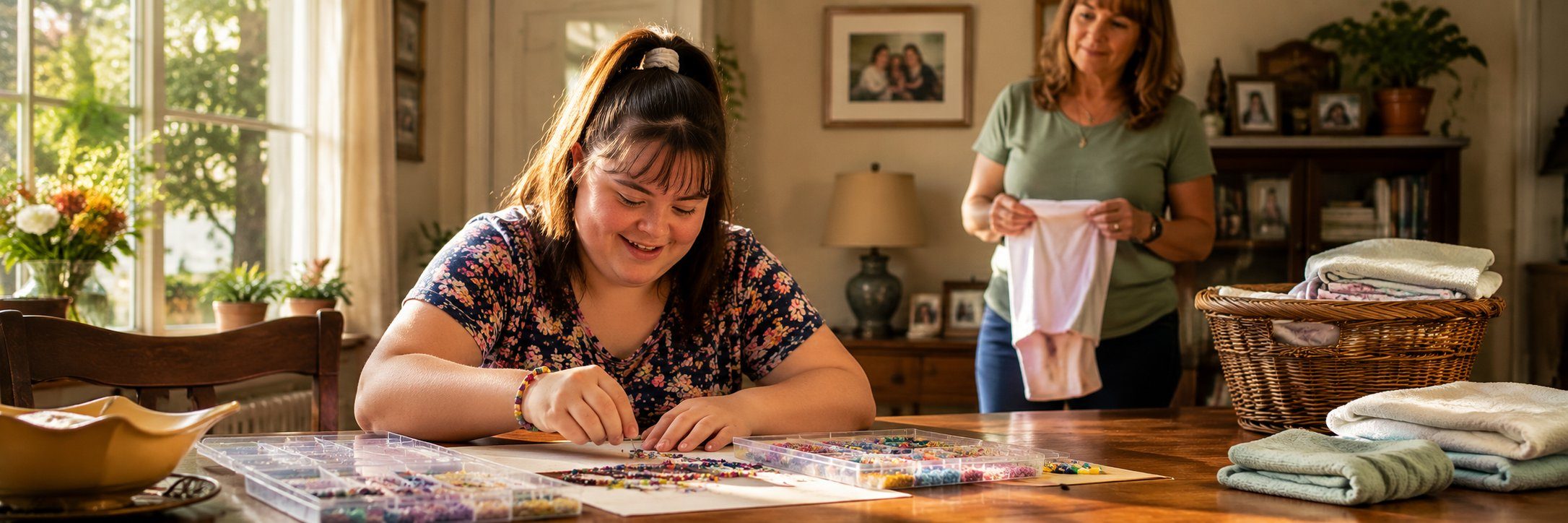
If you, a family member, or friend cares for a disabled loved one, you may have heard about a California program called In-Home Supportive Services, or IHSS. You may have also heard about a special designation of care referred to as protective supervision. This article will attempt to explain the very specific needs qualifications to receive IHSS protective supervision.
What Protective Supervision Actually Is
Protective Supervision is a level of care designation. There are multiple factors, but mostly it means that your loved one is disabled to such a degree that they require 24 hour a day monitoring to remain safe. IHSS requires a medical provider to document the recipient's mental impairment and need for supervision, and a county social worker uses that evaluation as part of the eligibility determination.
In most cases, IHSS recipients who don't qualify for protective supervision have a maximum number of hours capped at 195 per month. Protective supervision increases those hours up to a maximum of 283 hours per month. Protective Supervision means the recipient is disabled to such a degree that they require a provider to observe and monitor their behavior, and to intervene when necessary to prevent injury, accident, or harm. The provider is there to watch, redirect, or physically intervene when the recipient would otherwise put themselves in danger.
The Two-Part Eligibility Test
As mentioned previously, Protective Supervision is not available to everyone who receives IHSS. It requires a specific eligibility finding, and that finding has two parts that must both be met.
The first is that the recipient must have a mental impairment or mental illness. A physical disability alone does not qualify. The need for supervision has to come from a cognitive or psychiatric condition, not a physical one.
The second is that the recipient's behavior must be nonself-directing.
What is nonself-directing? Nonself-directing behavior means that due to a mental impairment, mental illness, or confused state, the individual is unable to assess danger and the risk of harm, and would most likely engage in potentially dangerous activities that could cause self-harm. The question is not about the diagnosis. The question is whether the person's behavior demonstrates an inability to recognize and avoid danger.
Both parts of the test must be present. Mental impairment without nonself-direction does not qualify for protective supervision. This is a common source of denials, particularly for adults with conditions that affect mental capacity, but whose dangerous behaviors are not well documented in the record.
The county social worker evaluates nonself-direction by looking at three areas of mental functioning: memory, orientation, and judgment. Each is rated on a three-point scale. These are also the three primary categories on the SOC 821 form.
Memory refers to the ability to recall learned behaviors and information. A severe memory deficit might look like forgetting to complete daily activities important to health and safety, being unable to maintain continuity of thought, or not knowing one's own age or address.
Orientation refers to awareness of time, place, and other people. Severe disorientation can include wandering off, inability to recognize familiar people, or no awareness of the purpose of a social worker's visit.
Judgment refers to the ability to make decisions without putting oneself at risk. Severe impairment of judgment can include an inability to understand the danger of a hot stove, sharp objects, or an unlocked front door.
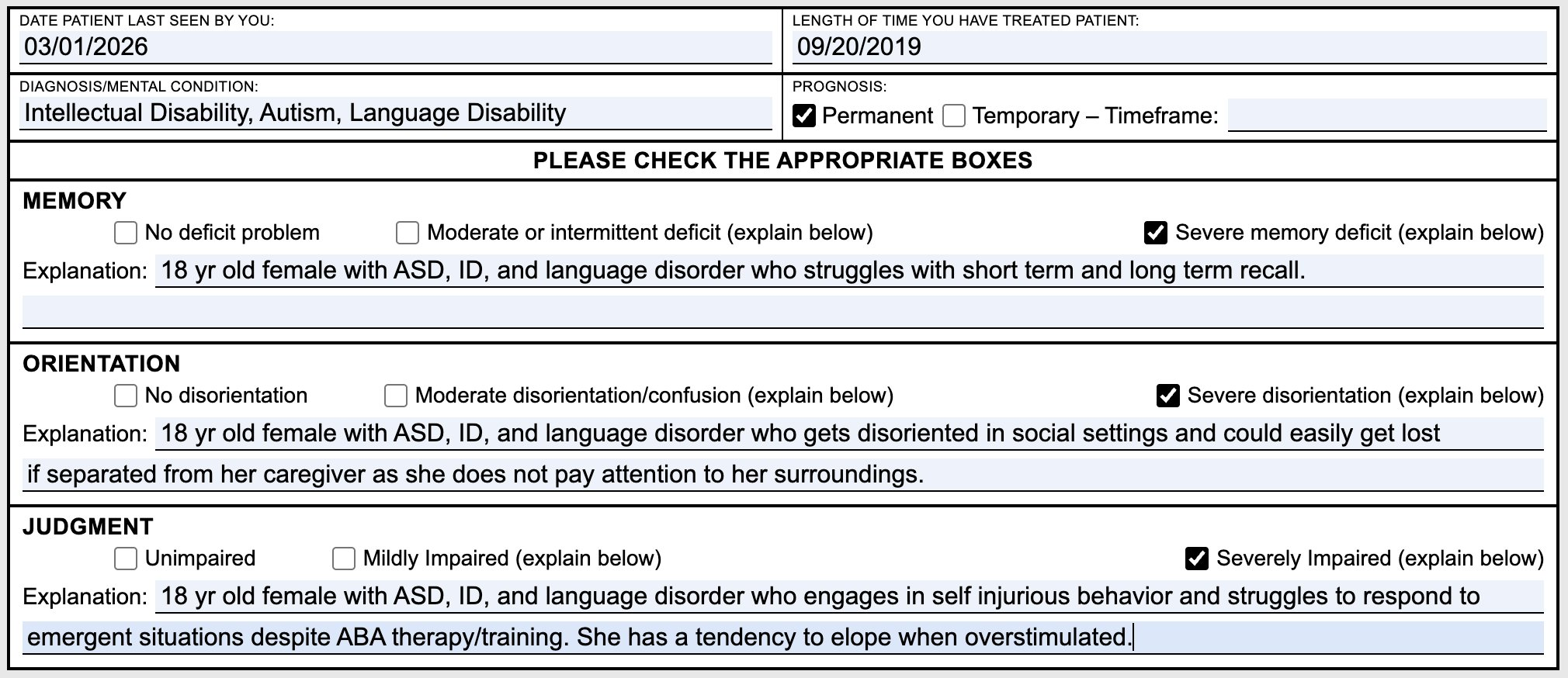
Applicants with severe deficits in all three areas are more likely to qualify than those with moderate deficits. This matters when your physician completes the SOC 821, the Assessment of Need for Protective Supervision form. A doctor who checks "moderate" across the board may cost a family their authorization. It's recommended to bring specific behavioral examples to the physician appointment, so the doctor has context when completing the SOC 821. Maintaining a protective supervision log throughout the year is a great way to document specific incidents for future assessments or medical evaluations.
You Do Not Have to Wait for an Injury
This is the policy that most families do not know.
According to CDSS policy, a person does not have to suffer an actual injury to be eligible for Protective Supervision. They only need to have a documented history of a propensity for placing themselves in danger.
CDSS provides a plain example in ACL 15-25: a person with a documented history of nonself-direction who has a tendency to open the front door and start walking away does not necessarily have to make it into the street for this to be considered potentially hazardous behavior.
The attempt counts. The near-miss counts. The pattern of behavior counts.
This means the log you keep at home may be the difference in your case. A hazard log is a continuous record, kept in real time, of what occurs throughout the year. It's a record of what happened and what you did to prevent it. During an assessment, a family with six months of documented incidents has exactly what CDSS policy requires. A family with nothing but their memory is relying on a social worker to believe them without evidence.
Other evidence of nonself-directing behavior can also come from physician evaluations, IEPs, and regional center documentation. The hazard log is just one piece of the overall package being presented during the social worker's assessment.
The 24/7 Requirement
Protective Supervision requires a 24-hour-a-day need. This does not mean the dangerous behaviors happen every minute. It means they are frequent enough and unpredictable enough that constant oversight is necessary.
The distinction between predictable and unpredictable behavior matters. If a child only touches the stove when a parent is cooking, the behavior is predictable and the need for supervision is limited to those specific times. That may not satisfy the 24/7 requirement. But if the child has also learned to turn the stove on independently, and does so at random times, the behavior becomes unpredictable. That kind of behavior does satisfy the requirement because the need for supervision is genuinely constant.
Unpredictable episodic behavior also qualifies, even if it does not happen every hour of every day.
What Does Not Qualify
Not every supervision need qualifies for Protective Supervision. The following situations are specifically excluded under CDSS policy:
- Friendly visiting or social activities
- Supervision caused by a physical condition rather than a mental impairment
- Anticipation of a medical emergency (seizures, heart attacks, strokes, etc.)
- Anti-social or aggressive behavior directed toward others
- Deliberate intentional self-harm
There is an important nuance regarding combative behavior. Head-banging as a manifestation of mental impairment, when the individual does not understand that it causes self-harm, can qualify. Intentional self-destructive behavior where the individual understands the consequence does not qualify.
The difference comes down to whether the individual can assess the danger of their own behavior.
Counties can also encourage environmental modifications, such as stove knob covers or cabinet locks, to address specific hazards. However, ACL 17-95 clarified that a county cannot require environmental modifications to eliminate the need for PS. If the modification removes one hazard but the underlying nonself-direction remains, the need for PS does not disappear.
Is it Routine Child Care?
For parents of children with autism and other cognitive disabilities, this is the section that explains the most common reason for denial.
Protective Supervision cannot be authorized for routine childcare or supervision. The supervision being requested must be meaningfully different from what a parent would provide to a neurotypical child of the same age. If the documentation describes the same kind of supervision any parent would provide to a six-year-old, the county will deny it as routine childcare and deny protective supervision.
The standard, drawn from the Garrett v. Anderson court settlement, is that the child must need more supervision than a minor of comparable age who is not mentally impaired or mentally ill. More supervision can mean more time, more intensity, or both. The additional supervision must be significantly more than routine childcare and must be related to the child's specific functional limitations.
A parent who documents that their child needs to be watched while playing outdoors has described routine childcare. A parent who documents that their nine-year-old child elopes into traffic when the front door is left unlocked, climbs furniture and jumps from heights without understanding the risk of injury, and has no awareness of physical danger despite repeated intervention, has described supervision that is fundamentally different from what any nine-year-old without cognitive impairment requires.
Entries in the hazard log should be something a neurotypical child of the same age would not do.
The Documentation Package
Getting PS approved comes down to documentation. The CDSS policy guidelines are on your side if you know how to use them. The near-miss standard, the propensity rule, the 24/7 requirement for unpredictable behavior, all of these are tools that work only when they are backed by evidence.
The core documentation package for a PS application looks like this.
SOC 821, Assessment of Need for Protective Supervision. This must be completed by a licensed health care professional. Do not wait for the county to send it to the doctor. Get it to them proactively. Doctor appointments can be weeks or months out, and delays in returning this form can delay authorization. Before the appointment, brief your physician on what "severe" looks like in the IHSS context, and bring specific behavioral examples they can reference. If the recipient has seen more than one physician or specialist, consider submitting multiple SOC 821 forms.
SOC 873, Health Care Certification. Required for all IHSS applicants before services can be authorized. Have this completed at the same appointment as the SOC 821 if possible.
IEP (for children). Focus specifically on language about behavioral goals, safety concerns, supervision requirements, and the need for more oversight than a neurotypical peer. Language in the IEP that speaks to safety, elopement risk, or self-injurious behavior is directly relevant to the PS eligibility framework.
Regional center records, psychological evaluations, and developmental assessments. Functional Behavior Assessments (FBA), Educationally Related Mental Health Services (ERMHS), speech therapy reports, and even a capacity declaration obtained during a conservatorship package.
Your hazard log. This is the bridge between the clinical record and the daily reality. Physicians and specialists see the recipient during appointments. They document diagnoses and deficits. The hazard log documents what happens between those appointments, at home, on ordinary days, in the moments that are too frequent to call 911 but too dangerous to ignore. That record, built consistently over time, is the evidence the propensity standard was written for.
Photographs. Every time an injury occurs, take a picture and document what happened in the hazard log. Cuts, scrapes, and bruises generally do not require medical treatment and therefore there will be no event record in the doctor's chart.
Free Tools for Parents and Caregivers
IHSS Unlocked offers two free Protective Supervision documentation tools available to any California IHSS family at no cost.
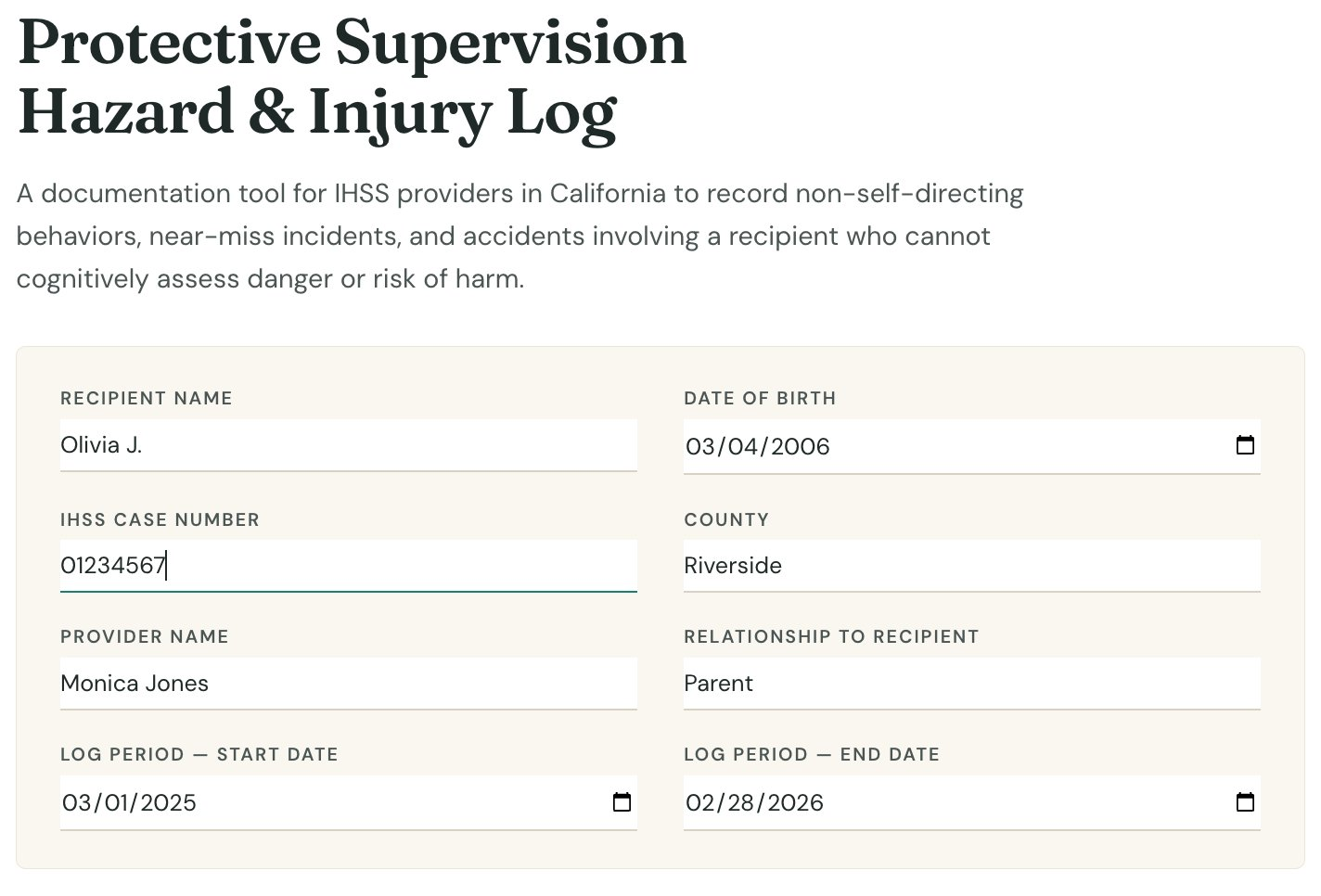
The PS Hazard Log is an interactive web-based tool. It includes a reference list of common non-self-directing behaviors organized by category, an entry log for documenting individual incidents with date, time, behavior type, intervention, and description, and a provider declaration for use at assessments and reassessments. Entries can be saved and returned to each time a new incident occurs.
The PS Hazard Log PDF is a print-ready version of the same tool, designed to be completed by hand, filed, and presented to a social worker as a formal paper record.
Both tools are available under the IHSS tab at ihssunlocked.com; look for Protective Supervision.
Other advocacy organizations like Disability Rights California offer free templates to document incidents requiring interventions.
Whatever tool you use, consistent documentation over time is what matters.
Denied; Act Fast
A denial is not the end. Every IHSS recipient has the right to a fair hearing to challenge a county determination, including a denial of Protective Supervision.
If you receive a Notice of Action denying PS, read it carefully. Since ACL 17-110 in 2017, counties are required to use standardized denial reason codes that specify the basis for the denial. The denial reason tells you exactly what the county found insufficient, which tells you exactly what the appeal needs to address.
Common denial reasons include a finding that the individual is self-directing, that the need is caused by a medical condition rather than a mental impairment, that the behavior is not dangerous enough or not frequent enough to require 24-hour supervision, or that the supervision described is routine childcare.
Each of those denial reasons corresponds to a specific policy standard and can be challenged with the right documentation at a hearing. If your prior PS hours have been reduced or denied, it's imperative that you file your appeal within 10 days of the Notice of Action letter. IHSS is required to send the NOA at least 10 days before the effective date of any change. Filing before that effective date triggers Aid Paid Pending, which means your current hours remain in place while your appeal is decided.
Is Representation Right for You
In a denial or reduction scenario, you can file the appeal yourself. The unfortunate reality is that a vast majority of providers simply cannot afford representation and the anxiety and uncertainty will certainly become overwhelming. The other unfortunate reality is that predatory pricing is not illegal, and many lawyers may see an opportunity to charge higher fees when clients are desperate for help. I know it's hard to believe, but it's true. There are, however, many lawyers or advocates that are extremely honorable and reasonable in their fee schedules. We were lucky to have found one ourselves who is amazing in her knowledge base, tenacity, and reasonable fees.
Here is a basic financial breakdown and why you might decide on representation even if it's a financial burden up front.
Example: A family receiving 283 hours of protective supervision who is suddenly denied after an annual evaluation may be reduced to the maximum non-protective supervision amount of hours, which is 195. A difference of 88 hours. Depending on your county pay rate, that could be anywhere between a $20,000 and $23,500 annual pay reduction.
A single PS denial can cost a family tens of thousands of dollars per year.
Retaining a lawyer just became the best investment you never thought you needed.
Why This Matters
Protective Supervision exists for one reason: to keep your loved one safe at home, where they belong, instead of in a facility. Everything in this article comes back to that.
The system is not designed to make it easy. The eligibility rules are narrow, the forms are confusing, and the burden of proof falls on you. That is not fair, but it is the reality, and knowing the rules is how you meet it.
Document everything. Keep the log. Take the photos. Get the SOC 821 to the doctor early. Bring your evidence to the assessment. And if you are denied, do not assume the county got it right. File the appeal, and get help if you can.
You know your loved one better than any social worker who spends an hour in your home once a year. The documentation is how you make them see what you live with every day.

Sources and References
- California Department of Social Services, ACL 15-25, Protective Supervision Clarifications, March 19, 2015. cdss.ca.gov
- California Department of Social Services, ACL 17-95, Protective Supervision Companion Cases and Clarifications, September 12, 2017. cdss.ca.gov
- California Department of Social Services, ACL 17-110, IHSS Protective Supervision Notice of Action Messages, October 31, 2017. cdss.ca.gov
- California Department of Social Services, ACL 20-111, IHSS Protective Supervision Proration Changes, October 13, 2020. cdss.ca.gov
- Garrett v. Anderson, Superior Court stipulated judgment establishing the standard for protective supervision for minors.
- Calderon v. Anderson (1996) 45 Cal.App.4th 607.
- Marshall v. McMahon (1993) 17 Cal.App.4th 1841.
- Disability Rights California, In-Home Supportive Services Protective Supervision, March 26, 2025. disabilityrightsca.org
- California Manual of Policies and Procedures (MPP), Sections 30-757.17 through 30-757.172, and 30-763.33.
- California Welfare and Institutions Code, Section 12300(b) and Section 12301.21.