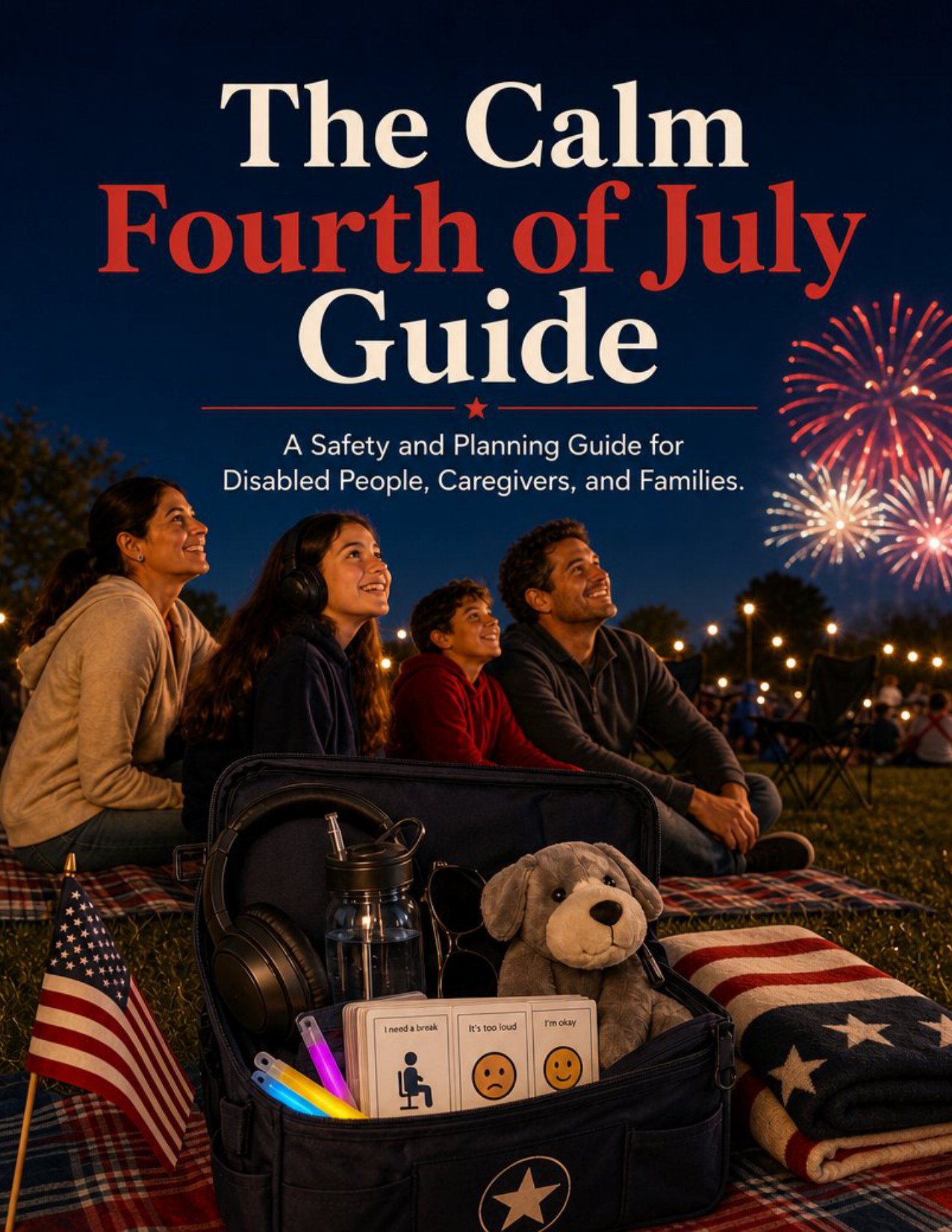
Why I Wrote This

I did not write this guide as a clinician. I wrote it as a father.
I am a college graduate, a Navy veteran, and I spent 25 years in law enforcement. I have experienced plenty of law enforcement trauma myself as a deputy sheriff. I have also personally witnessed and helped our military veterans through PTSD, as their crisis was building and at its peak. For me, service before self is not a slogan. It is how I live my life.
So when this guide talks about hypervigilance, startle response, and the way a single unexpected trigger can drop a person back into the worst moment of their life, I am not writing from research. I have seen it up close, in the people I served and the people I served alongside.
During my career, I also taught autism awareness to law enforcement and first responders: how to recognize it, how to slow down, how not to make a frightening moment worse, and most importantly, how to ask calm, directed questions to redirect an already stressful and difficult situation. I have stood on both sides of that encounter: the officer trying to help, and the parent praying the officer understands. I know what it is like to physically restrain a child to prevent self-harm, while wishing the trigger could have been prevented.
Because I am also the father of a daughter with autism. I know extreme sound sensitivity. I know elopement, the heart-stopping second when a child is simply gone. I know public meltdowns, flailing limbs, and the stares from people who have no idea what they are watching. I know what it is to love a holiday and dread it at the same time.
This guide is the plan I wish someone had handed me years ago. It will not make the Fourth of July perfect. No plan does. But a good plan can make it survivable, and sometimes, survivable is the win.
Mission Statement
The Fourth of July is not just a holiday. For a lot of our families, it is one of the hardest days of the year.
This guide exists for one reason: to help you get your person through it safely. Not to make the day perfect. No plan does that. But to give you a real plan, built ahead of time, so that when the booms start you are ready instead of reacting.
A good plan does not cancel the celebration. It makes the celebration survivable. And some years, survivable is the win.
How to Use This Guide
This guide is built to be used, not just read.
Read it once, all the way through, on a calm day before the Fourth of July. Then go back and use the parts you need. Every chapter stands on its own, so you can jump straight to the trigger that matters most for your person, the noise, the crowds, the elopement risk, whatever your day looks like.
The guide is in four parts. Part I helps you understand why the day is so hard and how to read your own person. Part II walks through the triggers one at a time. Part III turns all of it into a plan you can actually use. And the back of the guide holds the printable cards and a coloring section for your person.
A few things worth knowing as you go: every chapter and every card is on its own page, so you can print just the parts you need and leave the rest. The printable cards in Chapter 19 are meant to be filled out on a calm day and kept where you can reach them. Some of them work all year, not just on the Fourth of July. And the coloring pages at the very back are for your person, a calm activity and a way to bring them into the plan instead of having the plan happen around them.
You do not have to do everything in here. Take what fits your person and your day, and leave the rest. A plan that covers the three things most likely to go wrong for your person beats a perfect plan you never finish.
This guide was written for the Fourth of July, but the planning framework can help with many other major holidays and events too. Halloween, Thanksgiving, Christmas, New Year's Eve, birthdays, weddings, parades, graduations, and crowded family gatherings can all stack the same triggers: noise, lights, crowds, food changes, lost routine, long waits, and no easy way out.
The details may change, but the planning stays the same. Know your person's triggers. Reduce what you can. Have an exit. Plan for recovery.
This guide is educational and does not replace medical, legal, veterinary, emergency, or professional advice. For anything specific to your person, follow their doctor, care team, pharmacist, veterinarian, or local emergency agency.
Chapter 1 · Why the Fourth of July Is a Multi-Trigger Day
For most families, the Fourth of July means celebrating America, backyard barbecues, and a full day of fun with friends and family.
For families supporting a child or adult with significant disabilities, it can be one of the hardest days of the year.
Sometimes, one trigger is enough to cause a meltdown. But on a day like the Fourth of July, it is often not one thing. It is the slow build. Heat. Noise. Crowds. Smoke. Waiting. Hunger. Exhaustion. Too much excitement. Too little routine. A day that keeps asking more from a nervous system that may already be working hard just to keep up.
That is when manageable situations can become unmanageable. Small things suddenly feel huge. A change in food. A longer wait than expected. A crowded sidewalk. A bathroom that is too loud. A dog barking. A stranger too close. Then come the booms. The flashing lights. The smoke in the air. The traffic after the show. A whole day that stops following its normal shape.
Your person might handle any one of those things on a good day. It is all of them together, with no easy way out, that can push them past what they can carry.
That is also why the day is so hard to predict. A child who can watch fireworks from far away might fall apart when the crowd closes in. Another person might handle the crowd, then bolt at the first unexpected bang. Some make it through the whole evening smiling, only to come undone at home two hours later when it finally catches up with them.
If you have lived through that delayed crash, you already know it is real.
This guide is not about gritting your teeth and hoping for the best. You cannot always remove every trigger, but you can plan around them. Most of that planning comes down to four simple steps.
Predict. Know what is coming. Know which parts are likely to be hardest for your person. Almost everything is easier to handle when it is expected instead of sudden.
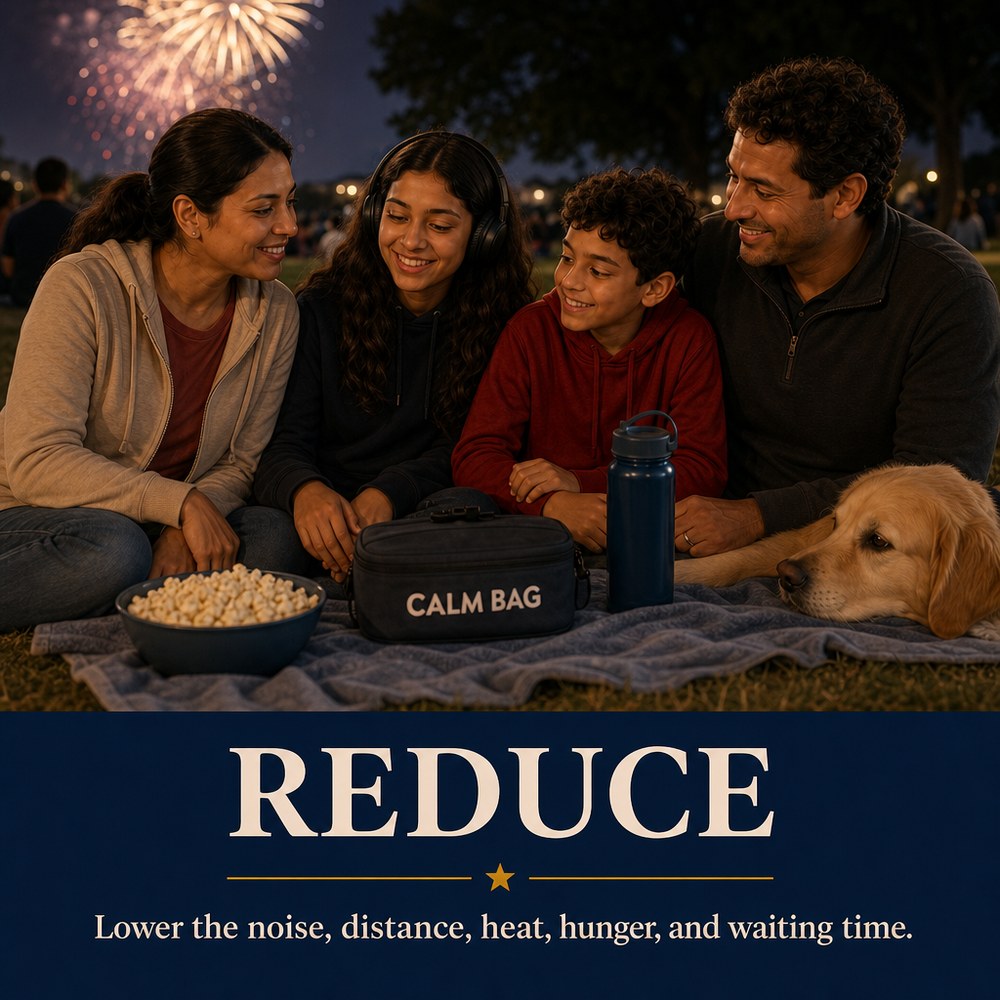
Reduce. Minimize whatever you can. Watch from farther away. Bring the headphones. Find shade. Keep water nearby. Have a quiet space ready. None of these fixes the whole day by itself, but small reductions add up.
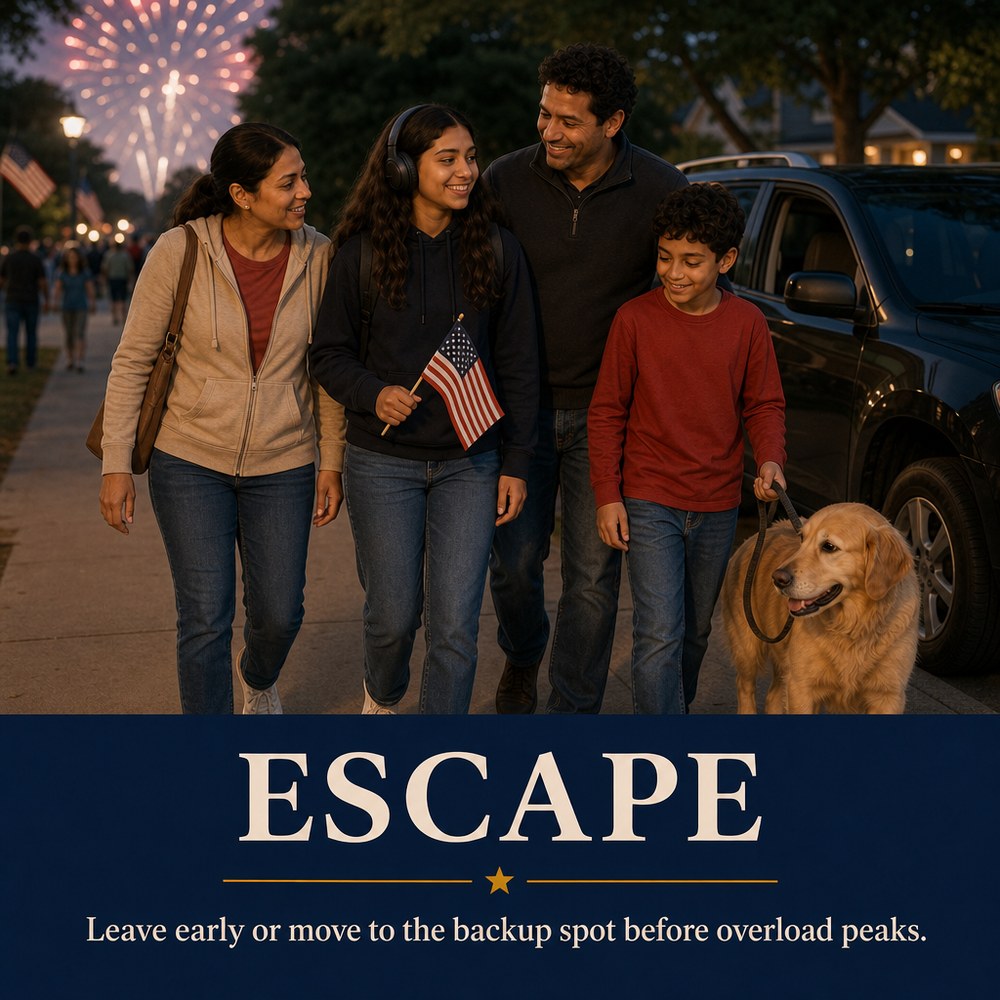
Escape. Know your way out before you need it. Know where the car is. Know where the quiet spot is. Know who is taking your person there if things go sideways. A good exit plan is not a failure. Sometimes it is the thing that saves the day.
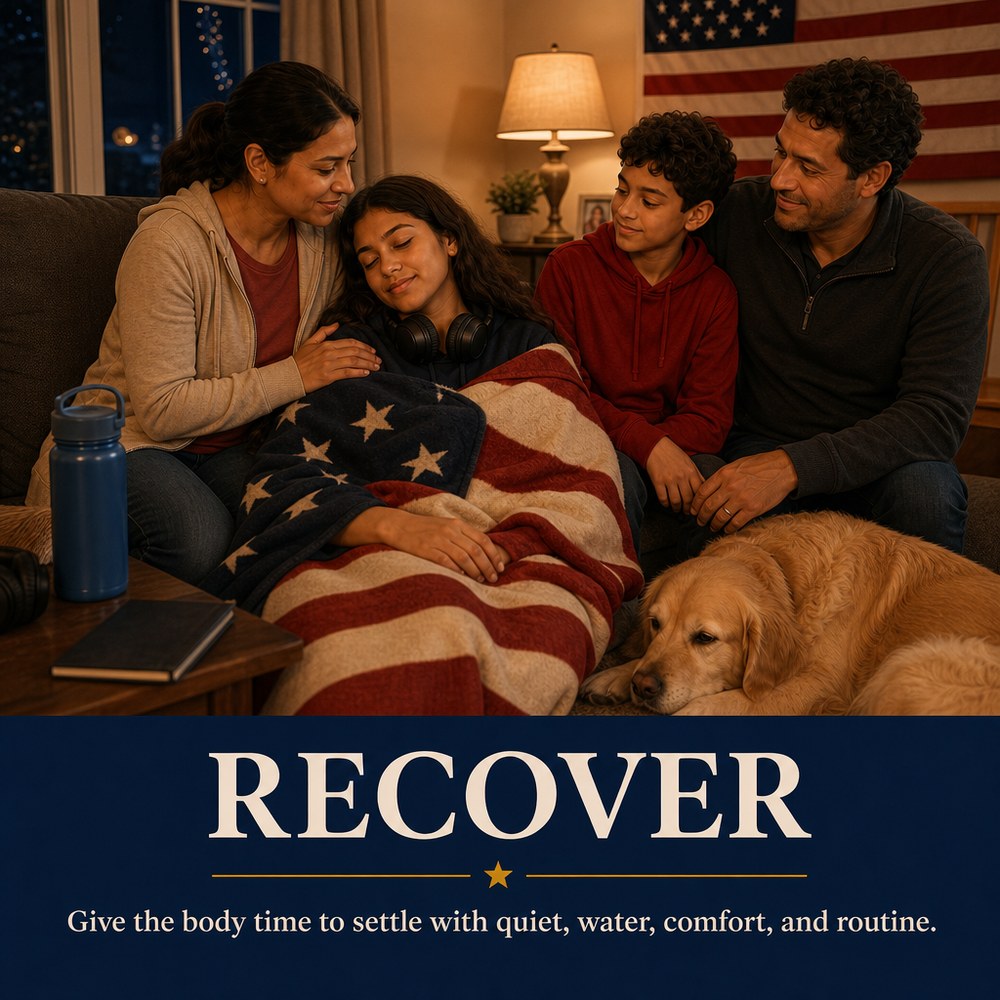
Recover. Plan for after, not just during. For many families, the fireworks are not the hardest part. The harder part is the crash that comes later, the rough bedtime, or the next day when the person is still trying to recover.
This guide is here to help you see the hard parts coming, plan around them, and give your person a better chance at getting through the day safely.
Nothing in the guide asks you to cancel the holiday. A good plan does not cancel the Fourth of July. It makes the Fourth of July a survivable day free of unplanned situations.
And some years, survivable is the win.
Chapter 2 · Know Your Person's Trigger Profile
Before you plan for any one trigger, start with your person. The specific kid or adult you love, with their own mix of what helps and what hurts.
For one person, the booms are the trigger. For another, the noise doesn't bother them but the crowd is unbearable. One falls apart in the moment. Another keeps it together all night and breaks down at bedtime. That is why a generic plan does not work, and why this one starts with your person.
This matters because the same holiday hits every person differently. If you plan for your person, every other chapter in this guide turns specific and useful instead of generic.
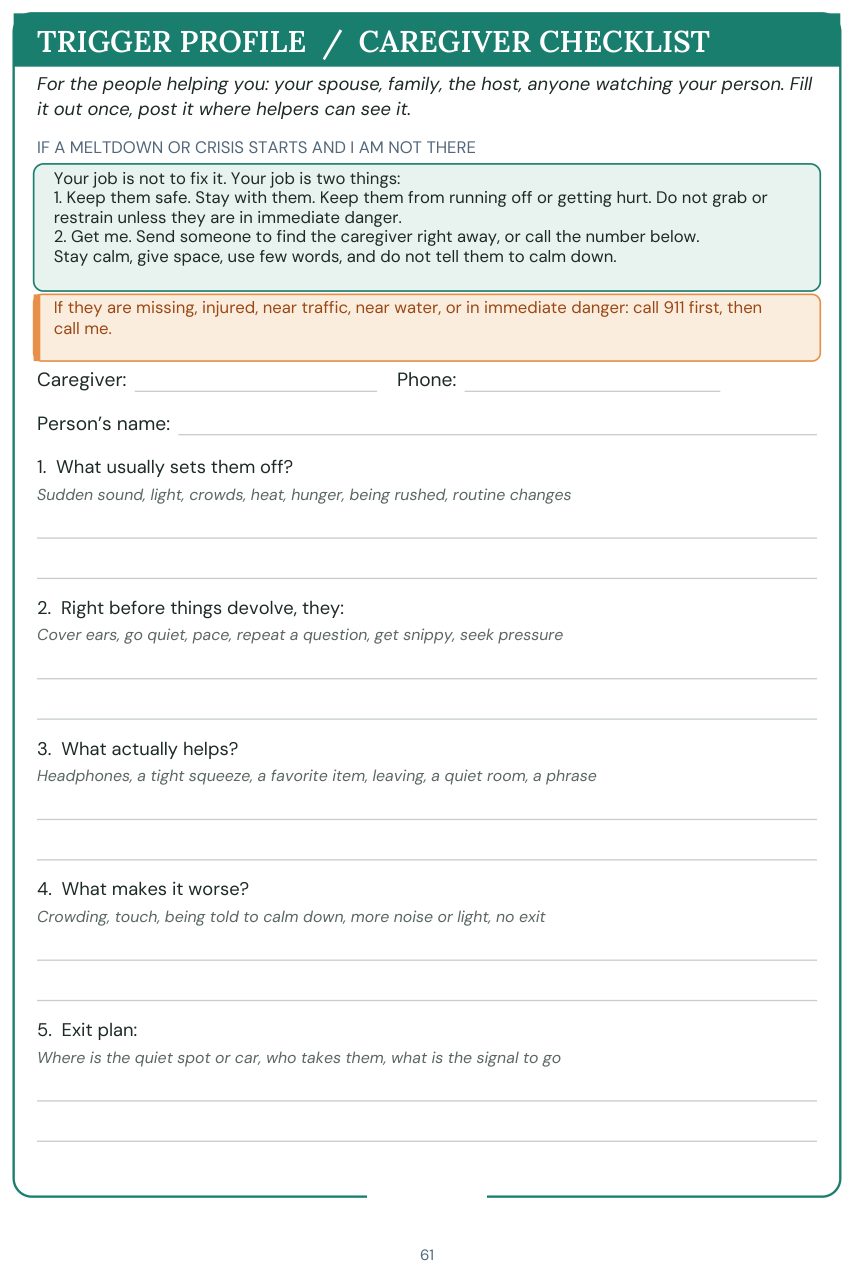
The quickest way to do this is to answer five questions before the Fourth of July and write the answers down somewhere you and anyone else helping can see them. Think of this as your Caregiver Checklist.
What usually sets him or her off?
Sudden loud sound? Bright flashing? Crowds and being closed in? Heat? Hunger? Being rushed? The routine changing? Be honest about the real triggers, not the ones you expect to matter.
What does it look like right before things devolve?
There are almost always early signs before a full meltdown or shutdown: hands over the ears, going quiet, pacing, the same question over and over, getting snippy, looking for pressure or a tight squeeze. If you catch the early signs, you can step in before it blows instead of after.
What actually helps?
Headphones? A weighted blanket or a tight hug? A favorite toy or object? Getting out of there? A quiet room? A certain phrase or little routine? Write down what has truly worked before, not what is supposed to work.
What makes it worse?
For a lot of people it is being crowded, being touched, being told to calm down, more light, more noise, too many voices at once, or feeling like there is no way out. Knowing this keeps a well-meaning relative from pouring gas on the fire.
What is the exit plan?
If it goes wrong, what do you do, and who does it? Where is the quiet spot or the car? Who has the one job of getting your person there? Decide this now, on a calm day, not in the middle of the meltdown.
Those five answers are the foundation for everything else in this guide. Fill it out once, keep it, and reuse it every year, adjusting as your person grows and changes. There is a printable version later in the guide so you can post it where the whole family can see it.
One last thing, and it matters: include your person in the plan whenever you can. Let them help make decisions when you are okay with it. A lot of people, including those who do not talk, understand far more than they can say back. When they are part of the plan, they know they are part of the plan, and that often takes the edge off the fear before the day even gets here.
Our daughter is usually happy, but being tapped can be a major trigger. In public, a simple tap to get her attention can turn into flailing arms, harsh language, and a full escalation fast. The lesson for us is simple: plan for the expected triggers, but leave room for the unexpected ones too.
The Four-Part Plan
This is the plan for getting through a hard day, on the Fourth of July or any other day. You predict what is coming, reduce what you can, escape when you need to, and help your person recover afterward. You will not control everything, but working through these four steps gives your person the best chance at a calm day.
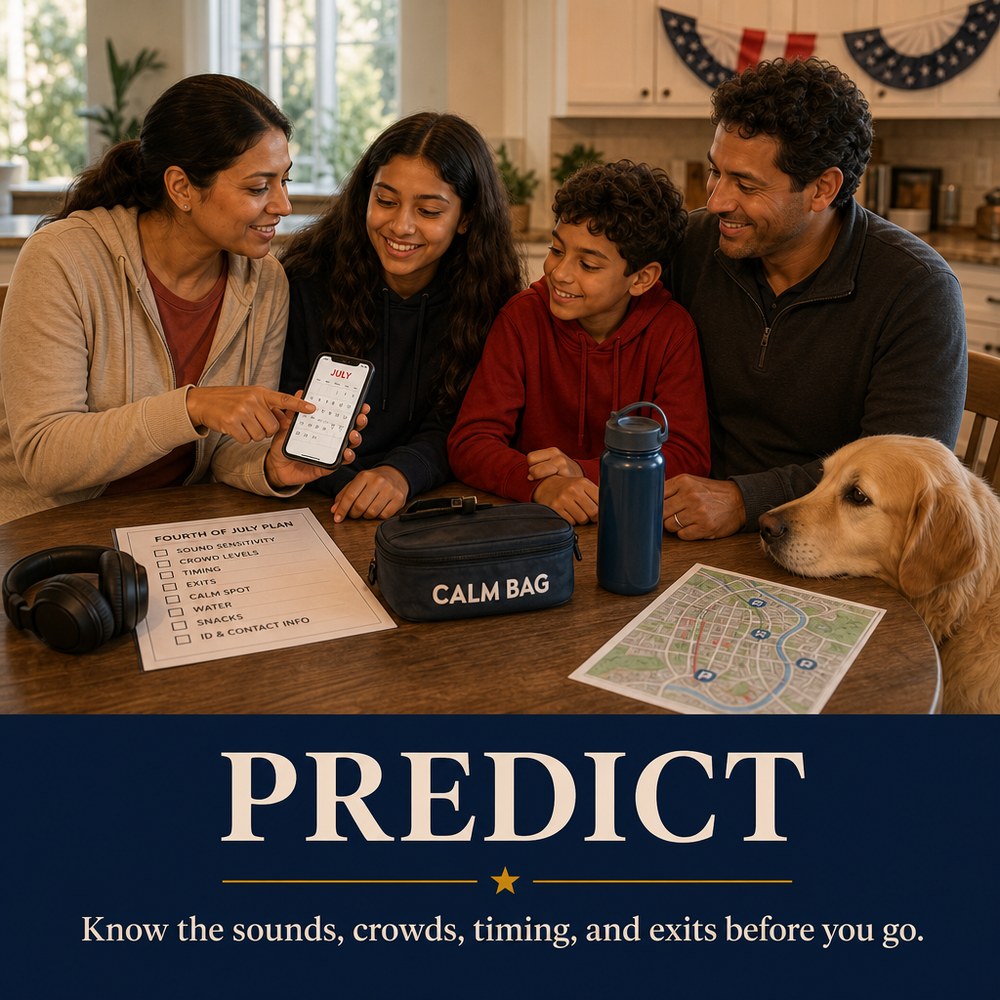
Chapter 3 · Explosive Noise and Hearing Protection
For a lot of our people, the noise is the worst part of the day. That's true whether your person is a small child, a teenager, or an adult.
It's not just that it's loud. It's that it comes out of nowhere if you're not paying attention. There's no warning before a firework goes off. One second it's quiet, the next there's a boom that you feel in your chest. For a person who's already on edge, that first blast can undo everything.
And it doesn't stop at one. Once it starts, it can go for hours. Neighbors set them off whenever they want, on the days before and after too. So even if you have a plan for the show itself, the random booms at 10 p.m. on July 2nd can catch you with your guard down.
Here's the part a lot of people don't realize: for some, it's not only the fear. The sound itself can physically hurt. Fireworks are loud enough to cause real pain and even damage hearing, especially up close. A person who covers their ears and screams may not just be scared. They may be telling you, the only way they can, that it actually hurts. For someone who is nonverbal, this can become a lasting problem they may never be able to explain.
Predict it.
You already know the noise is coming. Use that information to your advantage. Check when the local show starts so you're not caught off guard. Know that the days before and after the Fourth of July can be just as bad if not worse, because backyard fireworks are completely unpredictable. If your person does better with warning, give them one. For some, a heads-up that "tonight will be loud, and we have our plan" takes the edge off. For others, counting down to it only makes the dread worse. You know your person better than any rule here.
For us, we talk about it several times a day for about a week before the event. It's on the calendar. We reinforce the prior events that went smoothly and have a social story prepared ahead of time that we read over and over.
Reduce it.
The two biggest levers are distance and hearing protection.
Distance does more than people think. The farther you are from the source, the less the sound booms in the head and chest. Watching from inside the house, from the car, or from a hill far back can be the difference between a good night and a ruined one.
For hearing protection, you have options, and the right one depends on your person:
- Earmuff-style protectors (the kind you see on a shooting range or on airport ramp crews) block the most and are easy to put on and take off. Good for anyone who will tolerate something over their ears.
- Foam earplugs are cheap and small but don't work for everyone. Some people can't stand the feeling, and they're easy to pull out.
- Noise-reducing headphones or earbuds that play music or a familiar sound can work double duty: they cut the boom and give the person something steady to focus on instead.
Whatever you pick, don't let the Fourth of July be the first time your person wears it. Practice ahead of time, on a calm day, so it's familiar and not one more strange thing being forced on them in a hard moment. In the moment is not the time to try something new.
Escape it.
Even with hearing protection, some days the noise wins. That's not a failure. Have a quieter fallback ready before you need it: inside the house, a back room, the car with the engine on and music playing. Know where it is and who's taking your person there, so when you need it, nobody's figuring it out in the middle of the meltdown.
One last thing. If the noise is the main problem for your person, you do not owe anyone a live fireworks show. Plenty of families have better nights watching fireworks on TV or skipping them entirely and doing something calm at home. That's not giving up the holiday. That's running the holiday on terms your person can actually handle.
Recover it.
When the noise sends them up, the goal is usually to bring them back down and reset, not necessarily to call it a night. They went up. You bring them down.
Get them to the quieter spot. Re-read the social story you practiced. A favorite treat, the ice cream you saved for exactly this, can do more than any words. For us, what works alongside it is pressure and a slow, gentle pull on the joints, the wrists and elbows, never hard, just steady traction with a squeeze. That steady weight and pull tells the body it is safe.
Give it a few minutes. Let them land. More often than not, once they are back down, they are good to go for a while, and the night keeps going.
Only use pressure, squeezing, or joint traction if it is already part of your person's safe calming plan and they tolerate it. Do not force touch in a crisis, and ask an OT, doctor, or therapist if you are unsure.
Chapter 4 · Flashing Light and Bright Light
The noise gets all the attention on the Fourth of July, but for a lot of our people, the light is its own problem. Sometimes a bigger one than you'd expect.
There are really two different things going on here, and it's worth knowing which one applies to your person.
The common one: light that hurts and overwhelms
For a large share of our people, bright and flashing light is hard the same way loud sound is hard. It's not that they're being dramatic or difficult. Their brain takes in light at a lower threshold than most, so bright light, glare, flicker, and sudden flashes can genuinely hurt and overload them. Studies put the share of autistic people who react strongly to bright and flashing light very high, a majority even, not a rare few.
When it's too much, you see the same things you see with noise: covering the eyes, looking away, shutting down, getting agitated, hiding, melting down. And like the noise, a nonverbal person may have no way to tell you it hurts except by how they act.
Fireworks are a perfect storm for this. Big bright flashes, in the dark, one after another, with no rhythm you can predict. Add the bright party lights, the glare, the long day in the sun beforehand, and the eyes are taking a beating well before the show even starts.
Here's what helps:
- Sunglasses and hats are not just for daytime. A brimmed hat or sunglasses can take the edge off glare during the day and even soften bright flashing at night for someone who finds it painful. Tinted lenses help some people a lot. If your person will wear them, have them ready.
- Warm, dim light beats harsh, bright light. If your person has a hard time, the room you bring them to should be softly lit, lamps instead of overhead glare, not a brightly lit kitchen. Harsh white and blue light tends to be the worst; warmer light is calmer.
- Watch the close-up flashing more than the sky. The big show overhead, seen from a distance, is usually easier than fast flashing right in front of the face, strobe-style party lights, flashing toys, sparklers up close. Those put hard flicker right at eye level.
- Teach the simple escape move: look away, look down, or cover the eyes. The same way headphones help with sound, a person can learn that turning away or covering their eyes is allowed and helps. Pair it with the quiet space from the noise chapter, dim and away from the flashing is the goal.
I taught this to my first responder deputies. If you ever need to call police, tell dispatch that your person has sound or light sensitivities. When safe and appropriate, ask whether responders can avoid lights and sirens. At night, even an officer's flashlight can be a trigger.
The less common issue: flashing light and seizures
There's a smaller, separate group to mention, people whose seizures can be triggered by flashing light. This is real, but it's not most people, or even most people with epilepsy. Only about 3 percent of people with epilepsy have this kind of light sensitivity, and most people with epilepsy do not. It shows up more in kids and teens, and many grow out of it.
If your person has a seizure disorder, the question isn't whether to panic about fireworks, it's whether a doctor has ever told you flashing light is a trigger for this specific person. If you're not sure, ask before attending a Fourth of July event. The alternative could have very serious consequences.
A few facts that help: the flashing most likely to provoke a seizure is fast, roughly 5 to 30 flashes per second, and close enough to fill the person's entire field of vision. That's part of why distant fireworks are lower risk than close strobe lights. If a trigger ever catches you off guard, the standard move is to cover one eye completely with your hand and turn away from the light. Covering one eye, not both, cuts the trigger significantly.
Importantly: follow your person's doctor, not this guide. If your person has epilepsy, their neurologist knows their triggers, their medication, and their real risk better than any general guide can. If they take seizure medication, keeping it on schedule through a long, disrupted holiday matters, and we'll come back to that in the medications chapter. Nothing here replaces that medical advice.
For most families, though, the light on the Fourth of July is a sensory problem, not a seizure problem, and you handle it the same calm way you handle the noise: cut the intensity, give the eyes a break, and have a dim, quiet place to go.
Chapter 5 · Unpredictability and Lost Routine
For a lot of our people, routine is not just a preference. Predictability is what holds the whole day together.
When you know what is coming next, the world feels safer. You can relax a little because you are not constantly waiting for the next surprise. Take that away, and everything gets harder. A person who does fine on a normal Tuesday can struggle on the Fourth of July for one simple reason: nothing about the day is normal.
Many Fourth of July celebrations break everyday routines. Meals happen at strange times, get skipped, or include food that is not on the approved list. Nap time or quiet time gets skipped. Bedtime is way later than normal. You may be at someone else's house, a park, or a parking lot instead of home. There are different people, different smells, different sounds, and different expectations.
The whole day is different. A long stretch of waiting around for something loud to happen after dark.
For people who depend on routine, that is not always a fun day. To people without daily challenges, the chaos of a Fourth of July celebration may be manageable. To the people we care for, that same chaos can become too much.
Tell them what is going to happen before it happens
Most of us would hate being dragged through a long day with no idea what is coming next. Our people usually hate it more, and they may have less ability to adapt when the day keeps changing.
So walk them through it ahead of time. What are we doing? In what order? Where are we going? Who will be there? What happens when it gets loud? What happens at the end? For a lot of people, knowing the basic order of the day can take some of the fear out of it.
"This is how our day is going to go, okay? First, we go to the barbecue. Then we eat. Then we play or do a quiet activity. Then the loud part happens. Then we go home."
That's not fancy, it's just clear, and clear helps. This is why a social story or a simple picture schedule can be so helpful. A few pictures or a few sentences can lay out the day in order. You can read it together before the event, then point back to it during the day. It turns "What is happening?" into "Okay, this is the part we talked about."
We have a very basic laminator at home that was about $30. We use it to laminate important social stories so we can keep them for a few weeks or even months, depending on the situation.
Protect the routine as much as possible
You cannot keep the whole routine on a day like this. Do not try. Pick the few parts that matter most to your person and protect those. For many people, the big ones are food, quiet time, and medication timing.
If your person falls apart when they are hungry, feed them on time even if nobody else is eating yet. If they need quiet time in the afternoon to make it through the evening, talk to your host before the event instead of hoping it works out. If they take medication on a schedule, have it with you and set a reminder if you need one.
Also, remember that your person may not care about the party the way everyone else does. They may not care about the barbecue, the conversations, the decorations, or the fireworks. That does not mean anything is wrong. It just means their version of a good day may look different.
So bring the familiar stuff. Bring the tablet. Bring the favorite toy. Bring the safe snack. Bring the headphones. Bring the thing they like doing, even if it has nothing to do with the Fourth of July.
Hope is not a plan. Making a plan and keeping the most important parts of the routine close to normal can make the difference between a hard day and a completely unmanageable one.
Give them an end they can count on
One of the kindest things you can give a person who is struggling through a chaotic day is a finish line.
"After the fireworks, we go home."
"After dinner, we take a break."
"When the timer goes off, we leave."
Knowing there is an end, and knowing what that end looks like, can make the hard parts easier to handle.
Most importantly, be willing to change the plan when it is not working. No barbecue, party, parade, or fireworks show is worth pushing your person into a full-blown episode if you can see it coming. Even though they may not be able to verbally express their feelings, they'll remember this year, next year.
That's why the plan matters. Not because you are trying to control every second of the day, but because you are trying to give your person the best chance to get through it safely.
Chapter 6 · Communication Needs: When Distress Has No Easy Words
Most of this guide is about the triggers. This chapter is about something that sits underneath all of them.
When a person cannot easily tell you what is wrong, everything else gets harder. The noise, the crowd, the heat, the light, none of that is the real problem in this chapter. The problem is that your person may be hurting, scared, overwhelmed, or past their limit, and they may have no easy way to say so.
Think about what most of us do when we are overwhelmed. We say it.
"It is too loud."
"I need to leave."
"My head hurts."
"Give me a minute."
For a lot of our people, those words do not come. Or they do not come fast enough. Or they do not come at all once the person is past their breaking point. Some are nonverbal. Some can talk just fine on a calm day, but lose the words the second they are overwhelmed, which is exactly when they need them most.
So the distress comes out the only way it can. Covering the ears. Eloping. Hitting. Dropping to the ground. Melting down. It's the physical manifestation of words they can't say.
That's the whole point of this chapter. If you give your person a way to tell you sooner, you may be able to step in before behavior is the only message left.
Learn their signals before the loud day
Your person is already communicating, probably more than people realize. The job is to learn what those signals mean while things are calm, so you can read them when things are not.
Go back to your trigger profile from Chapter 2. What does early distress look like for your person? Going quiet. Pacing. Asking the same question over and over. Hands over the ears. The look. Moving closer to you. Pulling away from everyone else. Those things are not random. They are often the early version of the message, before it turns into a meltdown.
Give them a way to say, "I need a break"
The single most useful thing you can set up is a simple, fast way for your person to tell you they need out. Something that still works when they are overwhelmed. It does not have to be fancy. It can be:
- A break card they hand you or point to. One card, one job: this means, "I need to leave or pause now."
- A picture card or small set of cards: too loud, too bright, hungry, hurt, done. That lets them point to what is wrong instead of having to find the words.
- A gesture or sign you both agree on. A hand signal, tapping their chest, pointing to their headphones, or whatever they can do quickly.
- Their device or app, if they use one to communicate. Make sure it is charged, with them, and not buried in a bag when the moment comes.
Whatever you choose, two rules make it work. First, practice it on a calm day. Same as the headphones. Same as the quiet space. It has to be familiar before the hard moment.
Second, and this is the part people miss, honor it when they use it. If your person hands you the break card and you say, "Just five more minutes," you have taught them the card does not work. After that, they may stop using it. The card has to mean something every time, or it means nothing.
Tell the other adults how your person communicates
On the Fourth of July, you are often around people who do not know your person well. Family, friends, a host, neighbors, other parents. A relative who does not understand might talk over a meltdown, grab your person, crowd them, or push them to "use your words" at the worst possible moment.
Before the event, tell the people who will be around how your person signals they are done, what it looks like when they are getting overwhelmed, what helps, and what makes it worse. You do not owe anyone your person's full medical history. Just give them the practical information that keeps a well-meaning adult from accidentally making things worse.
Use fewer words when they are overwhelmed
In the middle of a hard moment, a person who is overwhelmed usually cannot handle more than one person helping them. More voices, more hands, more talking. It all adds up and usually makes things worse.
Often, the most helpful thing is fewer words, a calm face, and getting them to the quiet space. Not a lecture or a conversation about feelings. Just use simple words with affirming gestures and a soothing voice.
"Too loud."
"Break now."
"Come with me."
"We are going to the car."
Save the talking for later, when they are calm enough to take it in.
Communication runs underneath every other part of this guide. If your person can tell you "too loud" before they hit the wall, and if you can read the signs before the words run out, you have a much better chance of preventing the worst parts of the day. That is not a small thing. On the Fourth of July, it may be one of the most important things you bring with you.
Feelings cards have been an amazing blessing for our family. Our daughter carries them in her belt bag at all times. They are like a type of security blanket, so she can always point to her feelings if she's lost the words verbally.
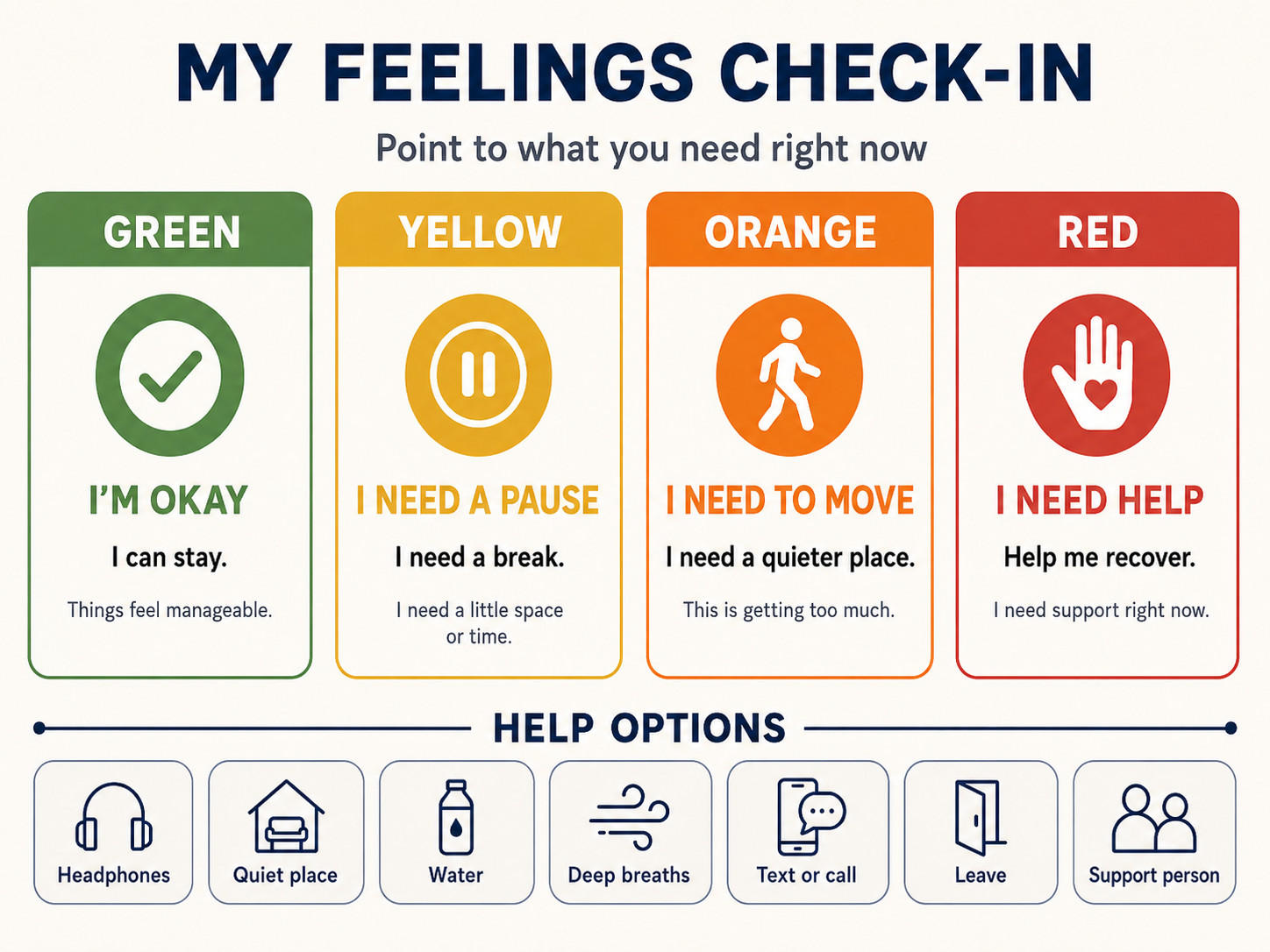
The board above is based on a color-coded check-in system. The idea is simple: when words are hard to find, a person can point to a color or a picture instead. You do not need this exact board. There are several places to find similar tools or build your own. The Zones of Regulation is one of the most widely used frameworks. The OT Toolbox has printable feelings and sensory tools for all ages. Autism Little Learners has visual supports and communication boards designed for daily use. We laminated ours so they hold up in a bag.
Chapter 7 · Crowds, Traffic, and Being Trapped
Going to a neighborhood event is managed differently than going to a large public event, and a lot of trouble comes from the unpredictability of the crowd.
Remember: triggers are additive. Your person may be able to handle noise. They may be able to handle fireworks lighting up the sky. But add those together, and things can start to go downhill. Add a large, unpredictable crowd, and now you may have the perfect storm.
Crowds can be their own trigger, and they are a big one. The sea of people. Strangers too close. Being bumped or touched. No clear space to stand. And the part that can do the most damage: no easy way to get out of the crowd. For a person who needs to be able to leave when things become too much, being packed into a crowd with no exit can create panic before a single firework goes off.
Think about what a big public show actually is. You usually park far away. You walk in with a river of people. You find a spot, and then more people fill in around you until you are boxed in on every side. The show ends, and everyone leaves at once, first through a bottleneck of people and then into a parking lot that turns into a sitting traffic jam. Even for people who love it, that is a lot. For a person who cannot tolerate feeling trapped, every part of that can become a problem.
Here is the good news: if you are going to a large public event, a lot of this can be managed by where you stand and when you move. You cannot control the crowd, but you can control your position in it.
Pick your spot for the exit, not the view
Everybody else is trying to get to the middle, up front, or wherever they think the best view is. Do not do that. Pick the edge. Stand near an exit, near the back, off to the side, or wherever you can walk away quickly without climbing over fifty people. If your person bolts or melts down, you want a clear path between you and the way out, not a packed crowd.
Park to leave, not to arrive
When you pull in, you are usually thinking about getting to the show as quickly as possible and not thinking about what happens after it ends. Instead: park where you can get out quickly. Face the car toward the exit if you can. Stay near an exit lane. Do not park deep in a packed lot where you will be stuck after the show.
Ten extra minutes finding a smart parking spot on the way in can save you an hour sitting in a hot car in a gridlocked lot with a person who is already done.
Leave before everybody else does
This is the big one. The worst crush of the whole night is usually the mass exit right after the finale, when thousands of people and cars all start moving at once. You do not have to be in that.
Watch most of the show from a spot you can leave from, somewhere your person feels safe and comfortable. Before the finale starts, begin your slow exit. You don't have to leave early, but you can position yourself near the exit so you get out quickly and ahead of the crowd.
Have the meeting spot planned
Before you are in the crowd, agree on two things with whoever is with you.
"Where do we meet if we get separated?"
"What is the signal that means we are leaving?"
That way, when your person needs to leave, nobody is debating it in the middle of the crowd. One person has the job of getting them to the car, the rest can follow, and you are already moving before it turns into a scene.
None of this is about avoiding crowds forever. It is about being in the crowd on terms you can get out of. Having a plan in place beforehand is the critical step for a successful outing.
Chapter 8 · Elopement and Wandering
The Highest-Stakes Safety Risk
This is the most important safety chapter in this guide. Everything else is about helping your person get through a hard day. This one is about keeping them alive.
Elopement is when a person bolts, wanders, or leaves the safety of a responsible adult or safe area without warning. Gone in the time it takes you to turn around. If your person does this, you already know the specific terror of it.
This is not the same thing as a kid testing limits or someone choosing to walk away. For many of our people, the deeper issue is nonself-directing. In plain English, that means they may not understand danger well enough to keep themselves safe.
They may not recognize traffic, water, strangers, distance, darkness, or getting lost as serious dangers. They may not respond to their name. They may not know how to ask for help. They may not be able to tell someone who they are or who to call.
The safety issue is not only that they leave. The safety issue is that once they leave, they may not be able to protect themselves.
For IHSS families, this is the same basic safety concern behind Protective Supervision. The person is nonself-directing and may engage in dangerous behavior without understanding the risk. Elopement is one of the clearest examples of why that matters.
Why the Fourth of July Makes It Worse
Elopement is a year-round safety issue, but the Fourth of July stacks on the exact conditions that make it more likely and more dangerous.
The day is loud, crowded, hot, and different. People come and go. Doors and gates open all day. Adults get distracted by food, guests, grilling, pets, fireworks, and cleanup. A person may bolt from a sudden boom, run from a crowd, or slip out a gate someone forgot to close.
And then comes the most dangerous assumption:
"I thought you had them."
At a gathering, everyone thinks someone else is watching. That is how nobody ends up watching. The most dangerous moment of all is when the fireworks start, because fireworks pull every adult's eyes in the same direction, up. For a person at risk of elopement, that is the moment they can be gone.
Name a Watcher
Do not rely on group supervision. One specific adult needs to have eyes on your person at all times. Not "we are all watching." Not "she's right here somewhere." One named person.
If that adult needs to step away, the job gets handed off out loud.
"I need you to watch her."
And the other adult answers out loud: "I've got her."
That handoff matters. Every time. Never assumed.
This is especially important during transition moments: guests arriving, food being served, people moving outside, fireworks starting, fireworks ending, packing up, and loading cars. Those are the moments when doors open, gates open, and supervision gets sloppy. That is when the watch gets tighter, not looser.
Make Them Findable Before They Are Lost
If your person cannot reliably tell someone their name, address, or phone number, put that information on them before the event starts. Use whatever works: an ID bracelet, shoe tag, clothing tag, card in a pocket, temporary safety tattoo, or GPS device if that is appropriate for your family.
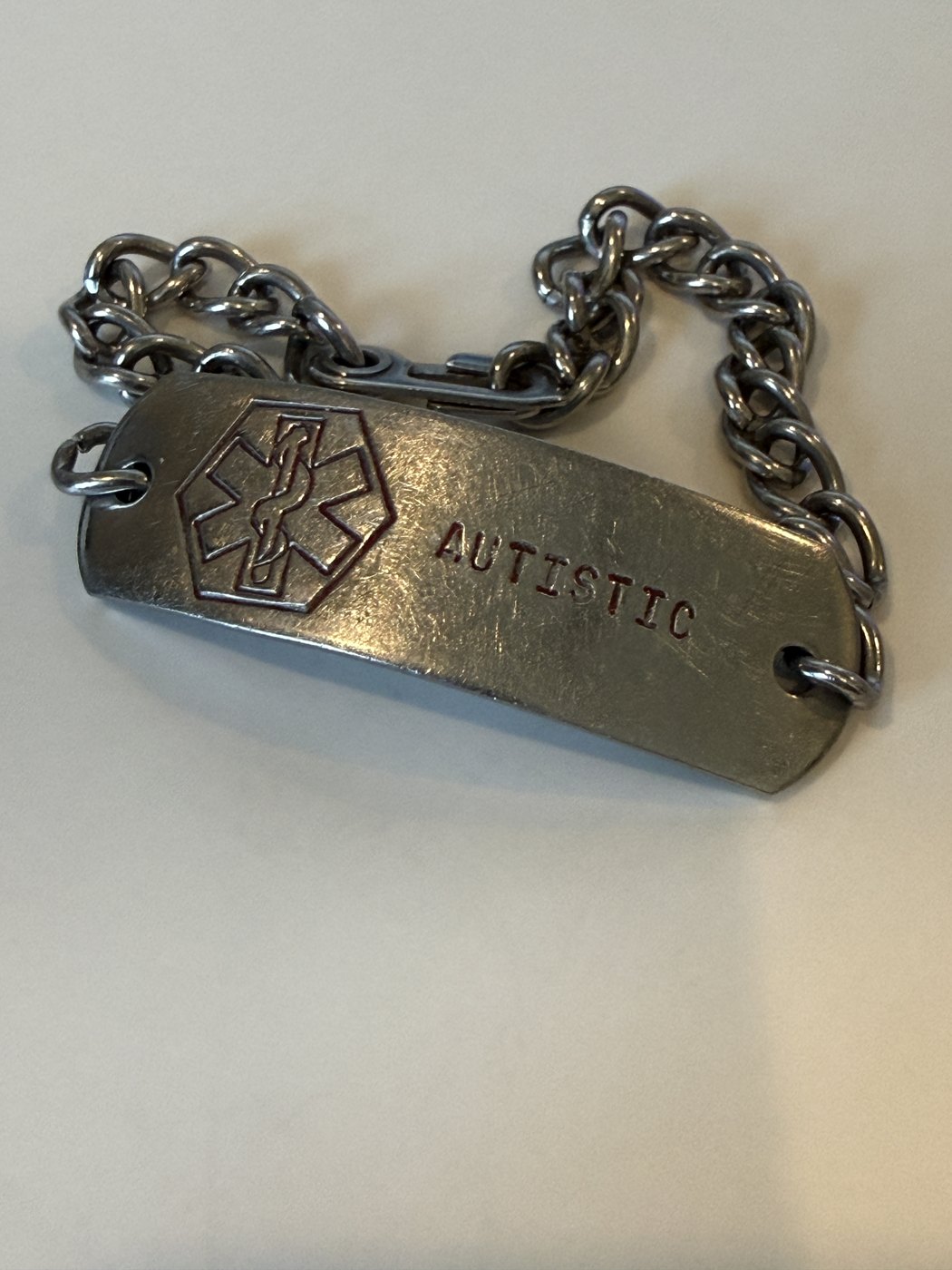
Plenty of options exist at every price point, MedicAlert, RoadID, even Etsy. Whatever you pick, keep the design simple: first name only, a clear medical alert symbol, and a way to reach you.
Before you leave for an event, take a quick photo of your person in what they are wearing that day. Do not forget the shoes. If something goes wrong, you do not want to waste time trying to remember the shirt, shoes, jacket, or favorite item they may be carrying.
You can also check ahead of time whether your local law enforcement agency has a voluntary registry for people with autism, dementia, developmental disabilities, or other conditions that affect safety and communication. If they do, set that up before the Fourth of July. During an emergency, it is too late.
Know What Your Person Is Drawn To
Water is one of the biggest dangers when a person elopes. A pool, pond, lake, creek, canal, drainage ditch, hot tub, or retention basin near a park.
When you arrive somewhere new, find the water before you relax, and ask about pools, gates, and backyard access in the neighborhood. If there is water nearby, that area gets checked first if your person goes missing.
But you know what your person is drawn to. For some it is water. For others it is trains, swings, elevators, animals, cars, or a favorite spot at the park. Whatever it is, be ready to check those places first.
If Your Person Is Missing, Move Fast
If your person goes missing, do not wait. Call 911.
At the same time, assign people to search the immediate area. Do not let everyone run in random directions. Give specific assignments and have each person report back. Do it clearly. Look Bob in the eyes and say:
"Bob, you check the pool and come right back." Make sure Bob answers: "Okay." Then assign the next person.
"You check the street." "You check the bathrooms." "You check the backyard." "You stay here in case she comes back."
Give out as many assignments as you have people to search. Every assignment ends with the same instruction: report back.
If you are the primary caregiver and the best person to give information to 911, resist the urge to run in every direction yourself. Stay as calm as you can and give clear information to the 911 call taker.
What to Tell 911
Use their name and your own real words. The list below is what information to give, not the exact phrases to repeat. When you call 911, give the information clearly and directly.
- "My ______ is missing."
- Your exact location: address, park name, cross streets, or landmark.
- "We are actively looking for them right now."
- Their age, height, build, hair color, and any identifying features.
- Whether they are autistic, have a developmental disability, dementia, or another condition that affects safety or communication.
- Whether they are verbal, nonverbal, or may not answer to their name.
- What they are wearing, including shirt, pants, bathing suit, shoes, colors, patterns, and anything they may be carrying.
- Their triggers, such as sound sensitivity, light sensitivity, fear of strangers, or running from people.
- What they are drawn to, such as water, trains, swings, elevators, animals, or a favorite nearby place.
Say this clearly:
"They may not answer to their name, and may be drawn to water."
That sentence matters.
If there is a backyard pool, start there, but do not stop there. Search the house too. Every room, every closet, under beds, behind furniture, inside cabinets, anywhere a person could hide or fall asleep. Search more than once. Have searchers report what they found or did not find to the person on the phone with 911.
You may find the conversation with the 911 call taker difficult. They are trained to ask direct and specific questions, often in an order you are not expecting. In that moment, it can feel frustrating. Try to stay with them. Their job is to get information and pass it to the dispatcher so police, fire, or medical personnel can respond.
When officers arrive, they may start by searching the house or the immediate area again. Do not be offended. It does not mean they do not believe you. It means they are trained to check the highest-probability places first.
On several occasions, I personally found missing kids inside the house after friends and family had already searched it. It happens, and it is okay. One child was sleepy and otherwise fine, tucked inside an ottoman with a lift-off cushion.
Most searches end quickly. But if time passes and your person still has not been found, there is one more thing worth knowing. Your 911 call will likely bring several officers to the scene, and probably a patrol sergeant coordinating the search. It is completely appropriate to calmly approach the supervisor and ask whether they think it might be time to consider a Silver Alert.
In California, a Silver Alert can be issued for a missing person who is developmentally disabled or cognitively impaired, not just for older adults. You are not demanding anything or telling them their job. You are a worried parent asking a fair question, and any good supervisor will take it that way.
A Silver Alert may be issued quickly depending on the facts known at the time: the severity of the disability, the age of the missing person, the time of day, the area, how long the person has been missing, and conditions like extreme heat or cold. It is a scary and uncertain moment, but a Silver Alert is not something initiated during the first call to 911.
Knowing the option exists, and knowing it is okay to ask, is one less thing to feel helpless about in a moment when helpless is exactly how you feel.
This chapter is heavy, but it matters. A named watcher. A real handoff. ID on your person. A current photo. Knowing what your person is drawn to. Calling 911 quickly. Giving clear assignments. None of that is overreacting. That is prevention. And on a day like the Fourth of July, prevention is the whole point.
Chapter 9 · PTSD, Trauma, and Startle Response
Every other chapter in this guide is mostly about your person. This one might be about you.
The Fourth of July can be hard on the people doing the caregiving too. Veterans. First responders. Survivors of violence. People who have lived through explosions, shootings, fire, combat, or other trauma. Anyone whose brain hears a sudden blast and reacts before the mind has time to catch up.
If that is you, this chapter matters and you are also part of the plan.
For someone with trauma, a firework is not just a loud noise. It can be a trauma cue. The sound, the flash, the smell of smoke, or the feeling of being caught off guard can put the brain right back into threat mode.
That is why the reaction can feel so fast. In that instant, the brain is not stopping to check whether it is a holiday. It is not calmly sorting out whether the sound is a firework, a gunshot, an explosion, or something else. It hears the blast and moves first.
Your heart rate jumps, your muscles tighten, your breathing changes, and your eyes start scanning the area. You may feel the need to move, get cover, get away, or get control of the space around you.
That is fight, flight, or freeze. For some people, it also shows up as hypervigilance, being on edge, watching every movement, tracking every sound, and waiting for the next boom before it even happens.
It is not weakness. It is not drama. It is not you being difficult. It is a brain and nervous system doing what they learned to do during a dangerous part of your life.
Knowing that may not make the reaction disappear. But it can help remove the shame. And shame is one more thing you do not need to carry on a night that is already hard.
Plan for yourself too
A lot of caregivers spend all their energy planning for everyone else. Everything on that needs list can apply to you too, like headphones, medication, and a safe ride home. That all matters.
But if fireworks are hard for you, you need a plan too. Tell someone close to you before the day starts. "This holiday is hard for me" or "If I need a break, here is where I am going." That is not making the day about you. That is giving the people around you a chance to understand what is happening instead of guessing.
Have your own exit
Everything this guide tells you to set up for your person can apply to you too. A quieter room. A place away from the crowd. Earplugs or headphones.
You are allowed to use the same plan you are building for everyone else. That does not make you less strong. It makes you prepared. Most importantly, it may be a way of re-grounding yourself so you are more present for your person.
Lower the input
If the sound is the trigger, turn it down any way you can. Close the windows, turn on a fan, run white noise or music. Wear earplugs or headphones. Watch from farther away and go inside before the finale. Those tools are not just for kids. They are not just for your person. They are for anyone who needs them.
The random fireworks are often worse
For a lot of people, the official fireworks show is not the hardest part. At least that has a start time. The harder part is the random explosion from down the street three days before, or the one that goes off after midnight when your guard is finally down. That unpredictability is what rattles people.
If it gets darker than that
If you are in crisis, or you are worried about someone who is, get help.
Dial 988, then press 1. You can also text 838255. You do not have to be enrolled in VA care to use it. It is for veterans, service members, and the people who care about them.
You matter in the plan
If you are carrying your own trauma into the Fourth of July, you are doing two hard jobs at once. Helping your person through the day, and getting yourself through it too.
You do not have to pretend the day is easy. Make a plan for yourself the same way you made one for your person. That is not selfish, and it does not make you any less of a caregiver. It is how you stay standing long enough to be the steady one when your person needs you.
Chapter 10 · Heat, Dehydration, and Medications
The Fourth of July is usually a long, hot day, and heat is one of those problems that can build quietly while everyone is focused on the fireworks later that night.
That is what makes it risky for our people. Some cannot tell you they are too hot. Some will not think to drink water unless someone reminds them. Some will not move to the shade on their own. Some will keep wearing the same jacket or hoodie because it is part of their routine, even when they are clearly overheating.
The usual warning signs we rely on, "I'm hot," "I'm thirsty," "I need to cool down," may not come at all, or may come too late. That means the adult has to be the one watching for it.
The basics still matter, and on a day like this, they matter more. Push fluids early, not just when your person asks. Find shade before they are miserable. Take breaks out of the sun. Dress them in lighter clothing if they will tolerate it. If plain water is a fight, bring a drink they will actually take. The goal is not to win a water argument at a barbecue. The goal is to keep them hydrated and safe.
Do not wait for your person to tell you they are overheating, because they may not be able to. Watch for the signs they cannot explain: a flushed or very red face, pale or clammy skin, confusion, unusual tiredness, dizziness, weakness, nausea, a headache, heavy sweating, or suddenly not sweating on a hot day. Also watch for the more subtle version, where they are just "off." Slower than usual. Irritable for no clear reason. Less responsive. Less steady on their feet. If your person cannot reliably tell you how they feel, those changes may be the warning.
If someone is hot and acting confused, seriously ill, or they stop sweating and seem worse instead of better, treat it as urgent. Get them to a cooler place, start cooling them down, and call 911.
The part a lot of people miss is medication. Some medications can make heat harder to handle. They can affect sweating, thirst, body temperature, heart rate, blood pressure, alertness, or fluid balance. That matters on a hot day that starts early, runs long, and may include hours outside before the fireworks even begin.
This does not mean you stop the medication. Never do that on your own. It means you ask ahead of time. If your person takes daily medication, ask their doctor or pharmacist a simple question before the holiday: "Does anything they take make heat or dehydration more dangerous?" Then ask what you should watch for on a very hot day. Also ask whether any medication needs to be kept out of heat, because a hot car, backpack, or stroller can be the wrong place to leave certain medications or medical supplies.
This is a thirty-second question during a regular visit or pharmacy pickup, but it can tell you whether your person needs extra caution in the heat. Follow their answer, not a general guide.
Heat also makes every other trigger worse. A person who is hot, tired, and dehydrated may have less tolerance for noise, crowds, waiting, food changes, and communication demands. They may not be "acting out." They may simply be running out of physical reserve.
So make heat part of the plan from the beginning. Bring drinks, and bring the preferred ones if that is what actually works. Build in shade and plan quiet breaks. Keep medication on schedule, and do not leave it sitting in a hot car. Watch your person's face, energy, and behavior throughout the day.
On the Fourth of July, heat can sneak up while everyone is waiting for the loud part to start. Your job is to catch it early, cool things down, and not let a preventable problem turn into the thing that ruins the day.
Sunscreen and sun protection
A long day outdoors is a long day in the sun, and sunburn is one of the most common and most preventable injuries on the Fourth of July. Put broad-spectrum SPF 30 or higher sunscreen on before you leave home, and reapply through the day, especially after sweating or water. A hat and shade do just as much. If the feel of sunscreen is a sensory problem, a stick or a brand your person tolerates, put on at home as part of the leaving routine, beats fighting about it in a parking lot. And if your person takes a medication that raises sun sensitivity, add that to the questions you already ask the pharmacist about heat. A bad burn makes the heat harder to handle and can quietly ruin an otherwise good day.
Chapter 11 · Smoke and Air Quality
This chapter is short, but it matters for a specific group: anyone with asthma, COPD, allergies, or other breathing problems.
Fireworks do not just make noise and light. They also make smoke, and that smoke can be hard on the lungs. On the Fourth of July, fine-particle pollution can spike, especially after the evening fireworks begin. For someone with asthma or another respiratory condition, that can mean coughing, chest tightness, wheezing, shortness of breath, or a full flare-up.
Backyard fireworks can be worse than people think. The smoke from fireworks set off down the street can stay low, right where everyone is standing and breathing. It does not always drift away like the smoke from a big professional show. Add barbecue smoke, summer heat, and in a lot of California, wildfire season, and you can end up with several sources of bad air stacked on the same day.
If your person has a breathing condition, keep their rescue inhaler or breathing medication with you, not at home in a drawer and not buried in the car. If they use one, the Fourth of July is exactly the day it needs to be in your bag.
Pay attention to where the smoke is going. If smoke is drifting toward you, move away from it. If a neighbor starts lighting fireworks nearby, go inside, move upwind, or get your person into cleaner air. On a day like this, indoors with the windows closed and the air conditioning running is usually going to be a better choice than standing outside in the smoke.
It also helps to check the air quality before you go, the same way you would check the weather. AirNow.gov lets you check the air quality in your area. If it is already a bad-air day because of heat, wildfire smoke, or local pollution, fireworks can make it worse. That may be the night to keep your person inside.
For someone with asthma, COPD, or another breathing condition, watching from indoors is not missing out. It is the safer plan. The goal is not to prove they can stand outside in the smoke. The goal is to keep a celebration from turning into a breathing emergency.
Chapter 12 · Food, Smells, and Cookout Safety
The Fourth of July is a food holiday, and that brings its own set of problems for our people. Some of it is sensory. Some of it is safety.
On the sensory side
Food is not always flexible. A cookout can be a whole table full of things your person does not eat, does not trust, or cannot tolerate. New foods. Foods touching each other. Foods that look wrong, smell wrong, or feel wrong. Then add the smells around the food: smoke from the grill, lighter fluid, sunscreen, bug spray, cologne, perfume, and trash cans sitting in the heat. For someone sensitive to smell, the food area alone can become too much.
The fix is simple: bring the food your person actually eats. Do not count on there being something they will accept at the cookout, and do not make the Fourth of July the day you battle over trying something new. A holiday full of triggers is not the day to expand anyone's palate. Pack what works and let that be one less thing that goes wrong.
If smells are the problem, use the same plan you have for noise or crowds. Move them away from the grill. Get them out of the smoke. Find a quieter spot. Go inside if you need to. A person who is already overloaded does not need to stand next to the barbecue just because that is where everyone else is hanging out.
The safety side
Two things matter most.
First, allergies. A potluck or cookout can be a minefield if your person has a food allergy. The food is often made by people who do not know your person, ingredients are not labeled, and cross-contact happens easily. If your person has a serious allergy, assume nothing on the table is safe unless you made it, brought it, or asked exactly what is in it. Keep allergy medication or epinephrine with you, not in the car. If your person cannot clearly communicate that they are having a reaction, you have to be the one watching for it.
Second, food sitting out in the heat. This is the one people forget. On a hot day, perishable food left out too long can become unsafe, and you cannot always smell or see the danger. Food can look completely normal and still make someone sick. The USDA rule is simple: perishable food should not sit out more than two hours. If it is hotter than 90°F, the limit drops to one hour. After that, throw it out.
That one-hour mark can come faster than people think on a hot Fourth of July. Do not let your person graze from a food table that has been sitting in the sun all afternoon. If you are not sure how long something has been out, skip it.
None of this is complicated. Bring what they eat, protect against allergies, and keep medication close. Be careful with any food that has been sitting in the heat. Food should be the easy part of the day. With a little planning, it can be.
Chapter 13 · Sparklers and "Safe-and-Sane" Fireworks
Sparklers look harmless. They get handed to little kids like party favors. That is exactly why people underestimate them.
Here are the numbers, straight from the Consumer Product Safety Commission: a sparkler burns at about 2,000 degrees Fahrenheit. That is hot enough to melt some metals. CPSC also reported about 1,700 emergency room-treated injuries involving sparklers in 2024.
That is not harmless.
And "safe-and-sane" does not mean safe. In California, it is a fireworks classification handled by the State Fire Marshal. It tells you what kind of fireworks may be legally classified and sold in places that allow them. It does not mean the firework is safe to hand to your person.
A "safe-and-sane" fountain or sparkler can still burn, scare, smoke, spark, and injure someone.
For our people specifically, this matters more, not less. A person who does not understand the danger, who might grab the hot end, wave it near their face, panic, drop it on their foot, or fail to let go when it burns, is exactly the wrong person to hand a 2,000-degree stick.
Same with anyone who cannot reliably follow, "Hold it away from you. Do not touch the tip. Do not point it at anyone. Drop it in the bucket when you are done." The thing that makes sparklers risky for any young child is even more serious for a person who is nonself-directing.
So the simplest move is the best one: skip the sparklers. Your person is not missing much, and the upside is nobody gets burned.
There is an easy swap that gives the same hold-something-glowing experience without the fire: glow sticks. Glow bracelets, glow necklaces, glow wands. They light up. They are fun to wave around. They come in every color. And they are cold.
For a lot of our families, glow sticks are the sparkler replacement that lets the person join in safely. There is a coloring page in the back of this guide built around exactly that: a child holding glow sticks instead of sparklers.
If you do allow real sparklers for other people at the gathering, keep your person back from them the same way you would with any open flame. Give space. Watch closely. And have a bucket of water ready for the spent ones, because sparklers stay hot after they go out.
The whole point is simple: sparklers are the firework most likely to be put directly in a child's or disabled person's hand, and they are hotter and more dangerous than they look. Trade them for something that glows instead of burns, and that risk goes away.
Chapter 14 · Pets and Service Animals
The Fourth of July is one of the hardest days of the year for animals, and that matters here for a reason people don't always think about: a panicked pet makes a hard day even harder for your person.
Start with the scale of it. More pets go missing around the Fourth of July than any other time of year. Shelters see a big spike in lost animals in the days right after, because the fireworks send dogs and cats into a blind panic and they bolt, through fences or even screen doors. A scared animal is not thinking. It is just trying to get away from the noise.
For our families, that's two problems at once. The pet's own safety. And what your frightened animal does to your person's day. A dog that's barking, shaking, pacing, or trying to escape is one more unpredictable, stressful thing in an environment that's already stressful enough. A pet in panic can trigger your person right alongside the fireworks.
On any given day, our golden retriever is super responsive to our daughter's distressing behaviors. He can just sense her anxiety building. He then whines and gets super panicky. His whiny panicking triggers our daughter right back, so then they're just feeding off each other.
So the pet gets a plan too, and it's the same logic as the rest of this guide: predict it, reduce it, keep them safe.
Keep them inside, in a safe space. Bring pets indoors before the fireworks start, into a closed room away from the windows, a closet, a bathroom, a den. Closed windows and a fan, the TV, or white noise to cover the booms. This is the single biggest thing you can do.
Make sure they can't get out, and can be found if they do. This is the day to double-check that the collar fits, the ID tag is current, and the microchip information is registered to you. Lost pets without current ID are much harder to reunite with their families, and a microchip only helps if the contact details are current. A few minutes before the Fourth of July is worth it.
Ask the vet ahead of time if your pet needs more. For an animal that truly panics, a ThunderShirt or snug wrap helps some dogs, and calming aids or anti-anxiety medication from the vet help others. The key is to ask before the holiday, not the night of, and if it's a medication you've never used, test it ahead of time so you know how your pet reacts.
A word on service animals. If your person depends on a service animal, know that being trained does not make a dog immune to fireworks fear. A service dog can still be rattled by the booms, and a working dog that's stressed and distracted may not be able to do its job when your person needs it most. Plan for that. Build the same calm, the hearing protection for the dog if it tolerates it, the quiet space, the distance from the fireworks, so the animal your person relies on can stay steady enough to keep doing its work.
The Fourth of July can be genuinely frightening for animals. For our families, that fear does not stay with the animal. It spreads into the room. Bring pets in early, keep them secure, make sure they are findable, and ask the vet ahead of time if your pet needs more help than a quiet room can give.
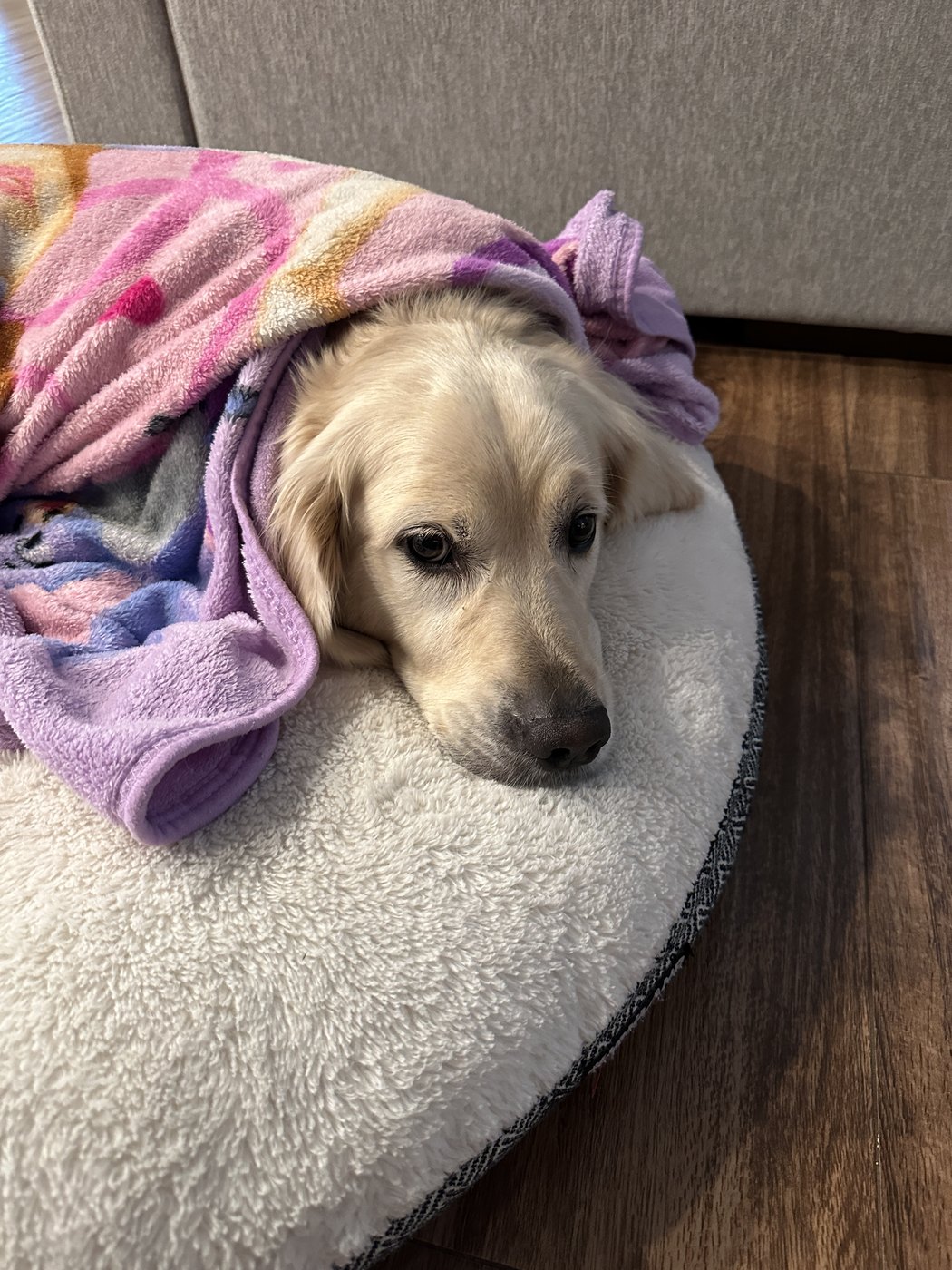
We've had dogs that weren't bothered in the slightest. My golden boy is not that dog. He will literally try to climb inside my shirt to escape the booms on the Fourth of July.
Chapter 15 · The At-Home Plan
For a lot of our families, the safest Fourth of July is the one you spend at home. That is not a consolation prize. Home is where you have the most control, and control is the whole game with a day like this. You know the space. You know where the quiet room is. You know what is in the fridge. There is no crowd, no parking lot, no long drive home with a person who is already done. If your person struggles with the public version of the Fourth of July, staying home is not giving up the holiday. It is running the holiday on the easiest possible setting.
But home is not automatically safe. It just gives you the best starting point. Here is how to use it.
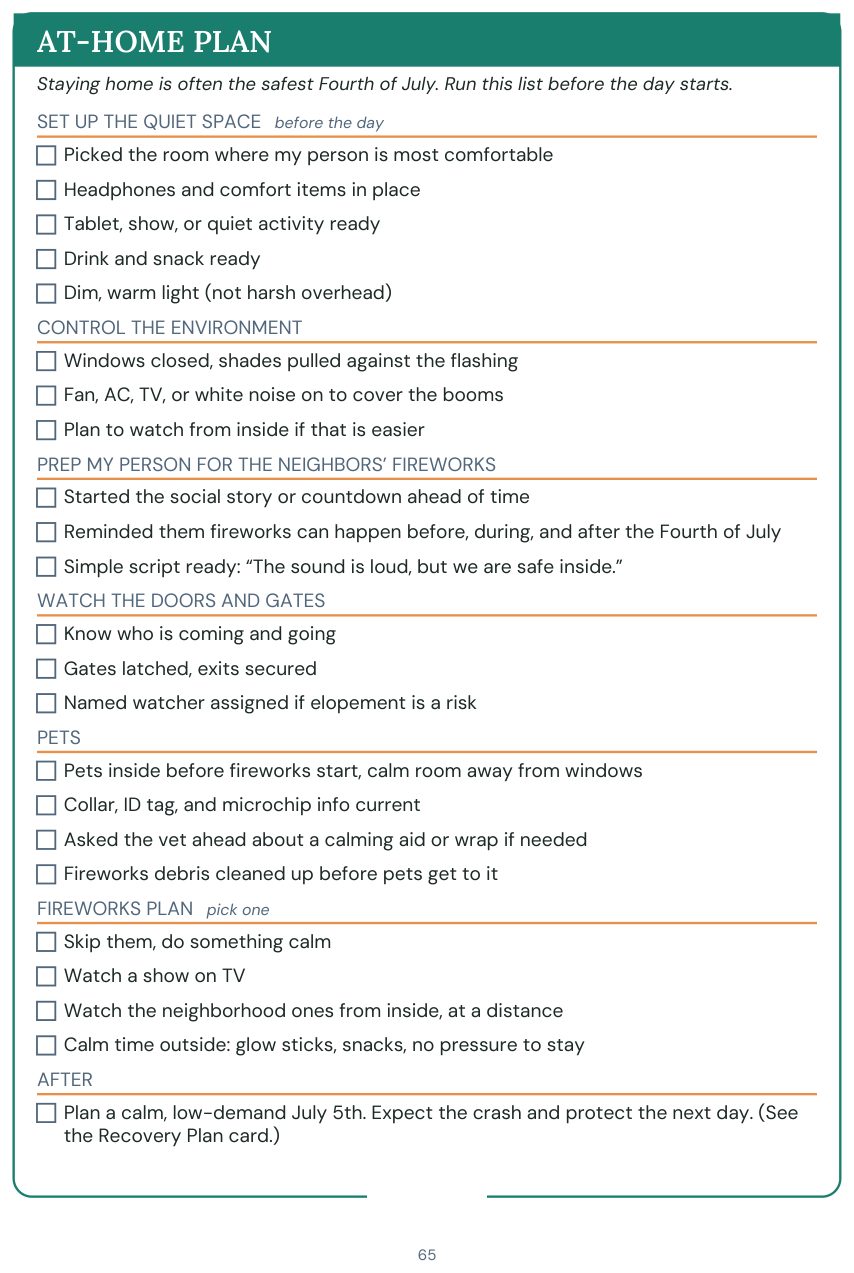
Set up the quiet room before the day starts.
Pick the room where your person will be most comfortable, and get it ready early, while everyone is calm. The headphones. The comfort items. The tablet or the show. A drink and a snack. Dim, warm light, not harsh overhead. This is the place they go when the booms start, and you want it ready before you need it, not thrown together mid-meltdown. You have read this in the noise and light chapters already; at home, you get to build it on purpose.
Control your own environment.
This is the home advantage. Close the windows. Pull the shades against the flashing. Run a fan, the AC, the TV, or white noise to cover the booms from outside. You cannot stop the neighborhood fireworks, but inside your own house you can turn the whole thing down in a way you never can at a public show. For a lot of our people, watching from inside with the windows shut is the difference between a hard night and a fine one.
Prepare for the neighbors ahead of time.
The random backyard fireworks are the ones that catch you off guard: the booms three days early, the ones after bedtime, the ones that happen when your person thought the holiday was over. You cannot control your neighbors, so prepare your person for the idea that fireworks may happen before, during, and after the Fourth of July. Start reading the social story a few weeks ahead of time. Use a simple script:
"Sometimes people set off fireworks early because they are excited for the Fourth of July. The sound is loud, but we are safe inside."
Watch your own doors and gates.
If elopement is part of your world, the Fourth of July has its own risk, covered in the elopement chapter. Guests come and go, doors open, gates get propped. If you are hosting or just home with the family, keep track of who is going in and out, and keep the exits secured the way you would anywhere else. The familiar setting can lull everyone into relaxing the watch. Do not let it.
Decide your fireworks plan in advance.
You have options at home, and you get to pick the one that fits your person. Skip fireworks entirely and do something calm. Watch the big fireworks shows on TV. Watch the neighborhood ones from inside through a window, at a distance. Or, if your person can handle being outside, keep it calm: glow sticks instead of sparklers, simple snacks, short visits outside, and no pressure to stay.
The whole point of the at-home plan is that you are not reacting to a day that is happening to you. You set the room, you set the environment, you set the fireworks plan, all before the first boom. Home lets you do that better than anywhere else. Use it.
Chapter 16 · The Public-Event Plan
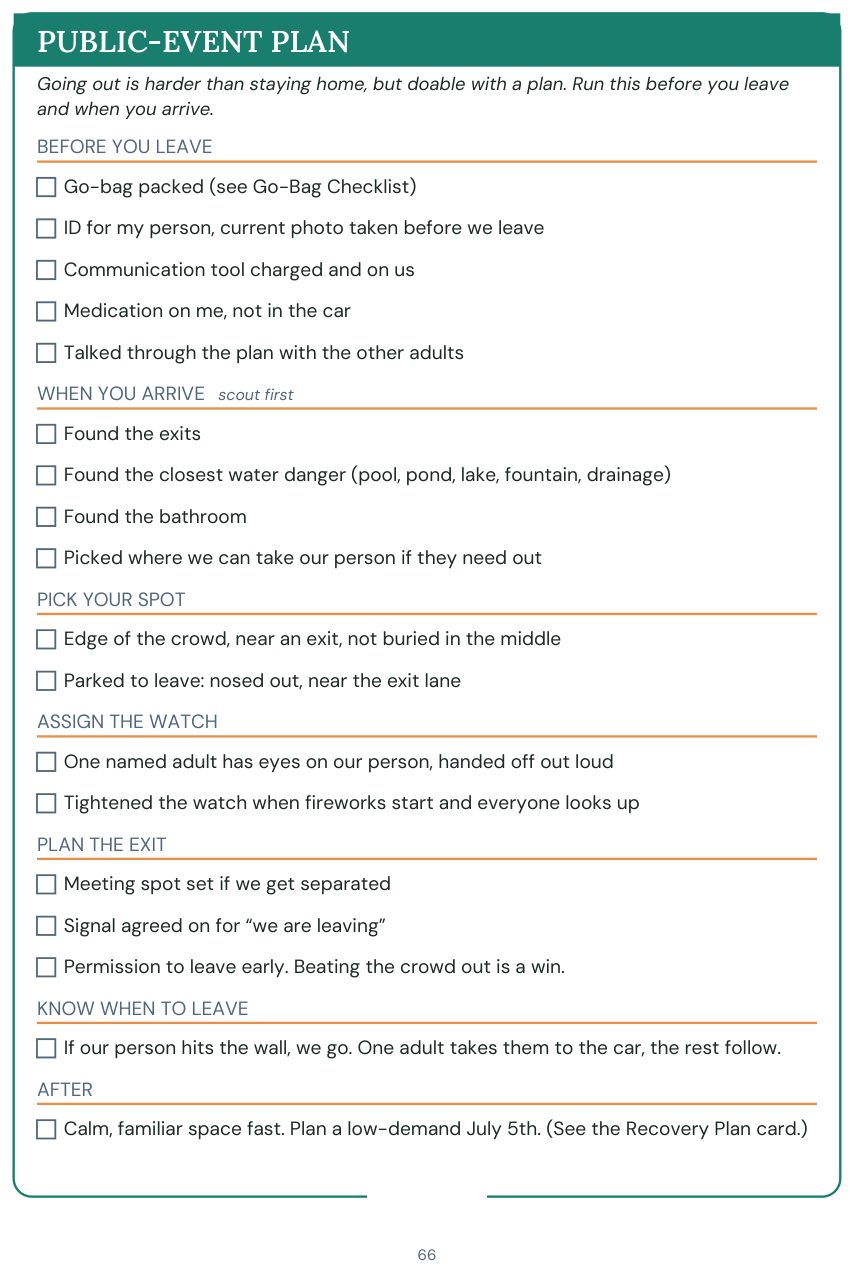
Sometimes you are going out, and that is okay. A niece's game. A family barbecue across town. A community show your person actually wants to see. The public Fourth of July event is harder than staying home, but with a plan, plenty of our people do it and do it well. The difference between a good outing and a bad one is almost always what you set up before you walk out the door.
This chapter pulls the going-out pieces together. The crowd and exit details live in the crowds chapter, and the safety side lives in the elopement chapter; this is the checklist version for actually leaving the house.
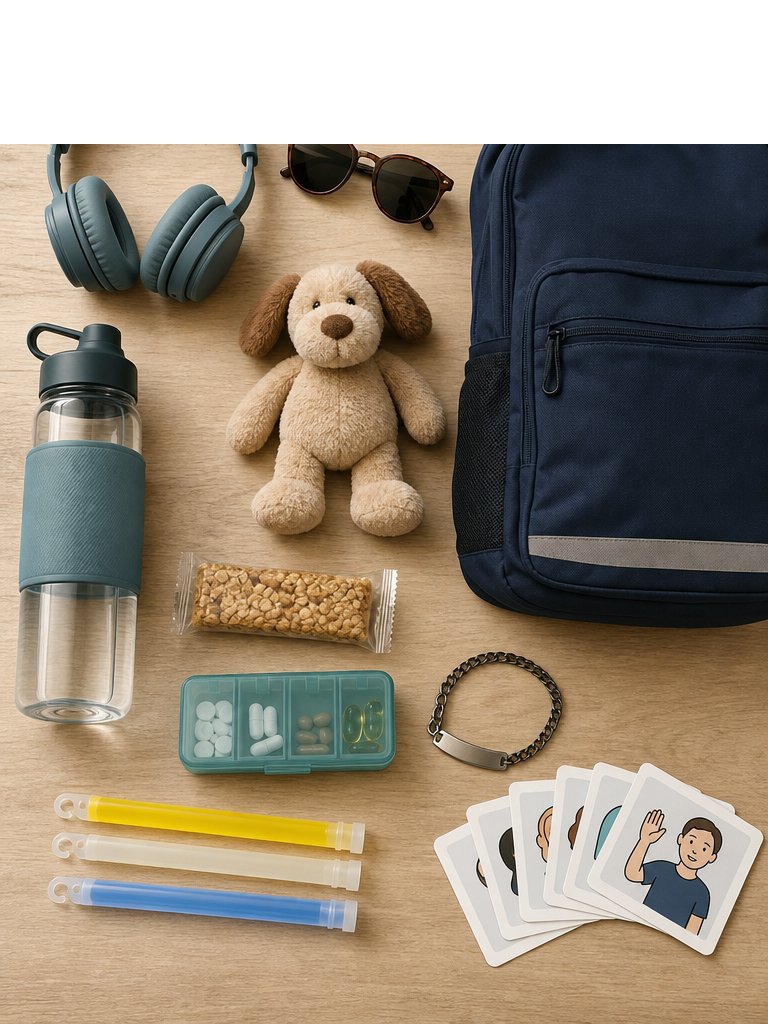
Pack the go-bag the night before.
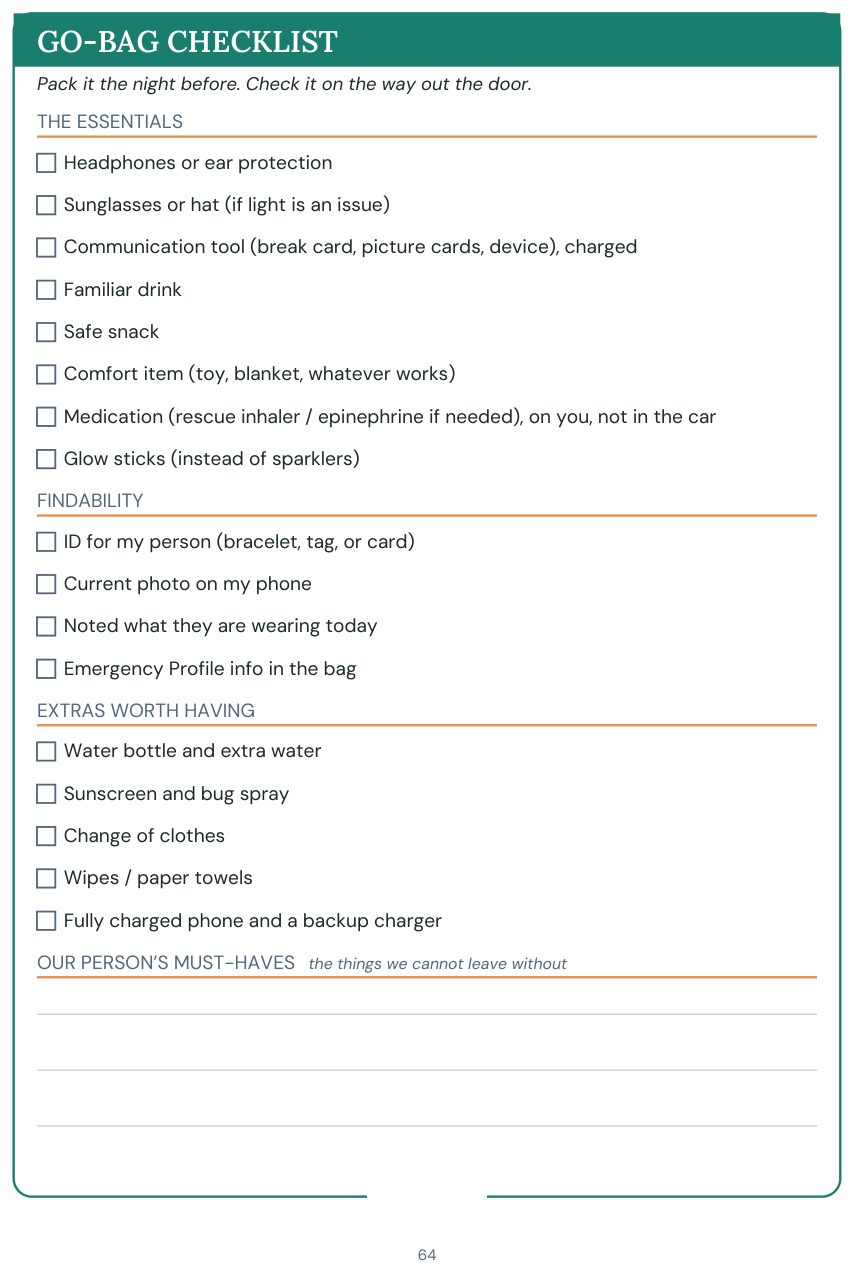
Do not throw it together on the way out when everyone is already keyed up. Have it ready the night before. The core list:
- Headphones or ear protection
- Sunglasses or a hat, if light is an issue
- The communication tool, break card, picture cards, device, charged and on your person
- A familiar drink and a safe snack
- Comfort item, the toy, the blanket, whatever works
- Any medication your person needs, including a rescue inhaler or epinephrine if that is part of your world, on you, not in the car
- ID for your person, and take a current photo on your phone before you leave
- Glow sticks instead of sparklers, if that is part of the plan
You built most of this list across the earlier chapters. The public-event plan is just making sure all of it actually leaves the house with you.
Scout the place before you settle in.
When you arrive, before you relax, do a quick read of the space. Where are the exits? Where is the closest pool, pond, lake, fountain, or drainage area, because the elopement chapter explains why water matters. Where is the bathroom. Where can you take your person if they need to get out. Five minutes of looking around when you get there saves you from figuring it out in a crisis.
Pick your spot for the exit, not the view.
Same rule as the crowds chapter, and it is the most important one for a public event. Stand at the edge, near a way out, not buried in the middle of the crowd for the best view. A worse view you can leave from beats a perfect view you are trapped in.
Assign the watcher, out loud.
If more than one adult is with you, one person has eyes on your person at all times, and the watch gets handed off out loud, exactly as the elopement chapter lays out. In a crowd, with the noise and the distraction, this is when people go missing. Decide who has the watch before you are in it.
Plan the exit before you need it.
Park to leave, not to arrive. Face the car out if you can and stay near an exit lane. Agree on the meeting spot if you get separated, and the signal that means you are leaving. And give yourself permission to go early. You do not have to outlast the finale. Beating the crowd out is often the move that saves the whole night.
Know your exit point.
The most important line in this chapter: you are allowed to leave. If your person hits the wall, the plan is not to push through it. The plan is to go. You did not fail because you left early. You succeeded because your person got out before it became the memory that ruins next year. One adult takes them to the car, the rest follow, and you are gone before it turns into a scene.
A public Fourth of July celebration is doable. It just takes more setup than staying home, because you are giving up the home-field advantage and have to bring your control with you in a bag and a plan. Pack it, scout it, watch it, and keep your exit open. That is the whole game.
Chapter 17 · Before, During, and After
A One-Page Framework
This is the whole guide on one page. Print it and scan it fast on the day.
Before the Day
- Fill out the trigger profile (Caregiver Checklist) and post it
- Start the social story or countdown a week or two ahead
- Pack the go-bag (full list in Chapter 16)
- Make sure your person has ID, and take a current photo the day of
- Set up the quiet space, at home or wherever you are going
- Decide the fireworks plan: skip, TV, watch from inside, or calm time outside
- Tell the other adults how your person communicates and what helps
During the Event
- One named adult has eyes on your person at all times, handed off out loud
- Watch for the early signs and step in before the meltdown
- Offer water and find shade, do not wait for them to ask
- Honor the break card every time, no five more minutes
- Keep your person near the exit, not buried in the crowd
- Watch the doors, gates, and water, especially when everyone looks up
- Know your exit point and use it. Leaving early is a win
After It Is Over
- Expect the crash and plan for it
- Get back to a calm, familiar space fast
- Protect sleep and the next day's routine
- Clean up fireworks debris before pets or kids reach it
- Tell your person what went well, even if you had to leave early
Chapter 18 · The Recovery Plan
Sleep, Calm, and the Day After
Most guides stop when the fireworks end. That is a mistake, and if you have lived this, you already know why.
For a lot of our people, the event ending is not the day ending. The hard part can come later, that night when bedtime falls apart, or the next morning when your person wakes up not right and you spend July 5th paying for July 4th.
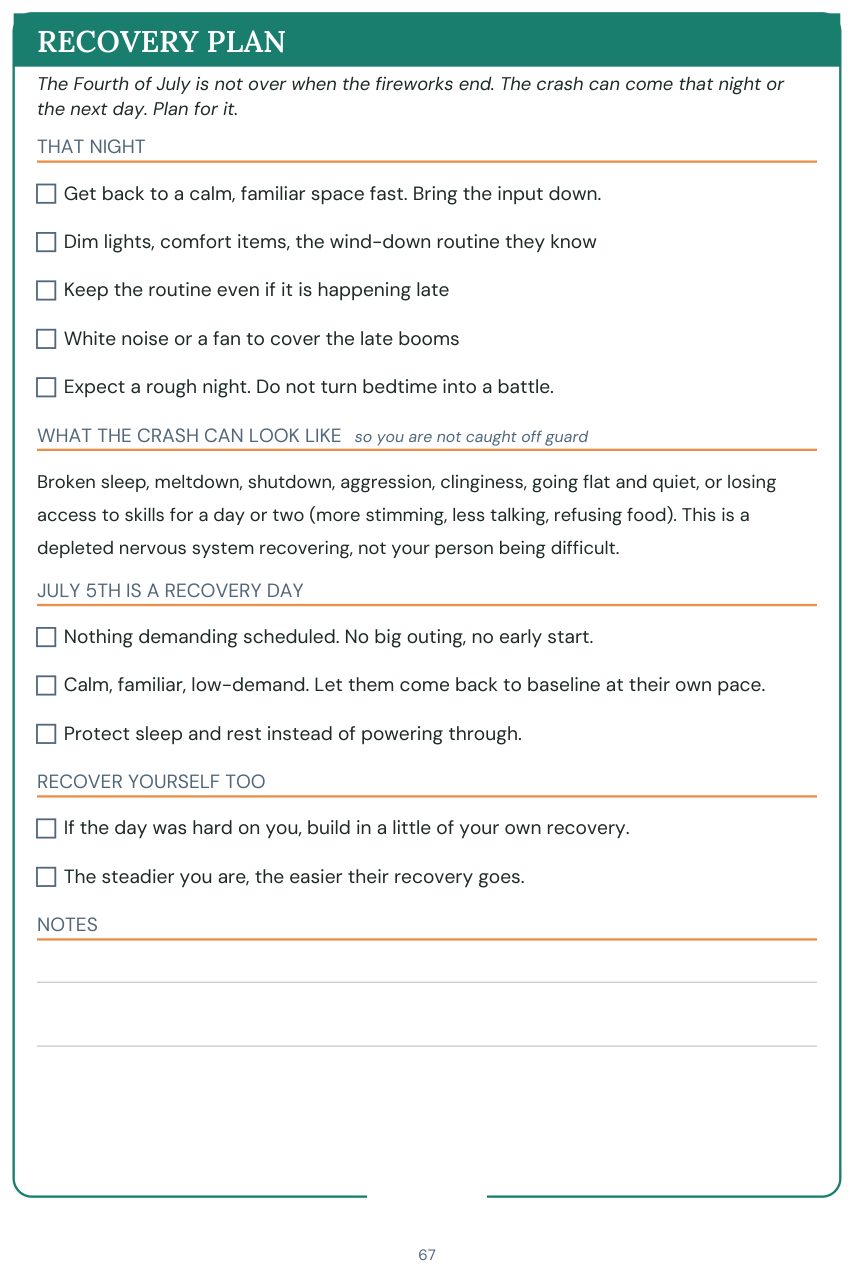
Know what the crash looks like.
After a long, overstimulating day, a lot of our people do not just bounce back. It can show up as broken sleep, meltdown, shutdown, aggression, clinginess, or going flat and quiet. Some seem to lose access to skills for a day or two: more stimming, less talking, refusing food they normally eat. This is not your person being difficult, and it is not you doing something wrong. It is a depleted nervous system recovering from a day that asked too much of it. Knowing it is coming takes some of the fear out of it.
Get back to calm fast.
When the event ends, bring the input down quickly instead of keeping the party going. Quiet, familiar space. Dim lights. Comfort items. The wind-down routine they know. The faster you move from overload to calm, the better chance you have of softening the crash. This is not the night to stop for ice cream if your person is already past their limit. Get them home and let them decompress.
Protect sleep, even if it is a mess.
Sleep is where the nervous system recovers, and it is also what the Fourth of July wrecks most. Keep the wind-down routine even if it is happening late. Use white noise or a fan to cover the late booms. Expect a rough night and do not fight it. Fighting it usually makes it worse.
Make July 5th a recovery day.
This is the most useful thing in this chapter: do not schedule anything demanding the day after. No big outing, no early start, nothing that asks your person to hold it together. Keep it calm, keep it familiar, and let them come back to baseline at their own pace. If you expect a slow day, a slow day is fine instead of a crisis.
Recover yourself too.
If the day was hard on you, you are part of this plan as well. Build in a little of your own recovery where you can. The steadier you are the next day, the easier your person's recovery goes, because they take their cues from you.
The Fourth of July is not over when the last firework fades. Expect the crash, move to calm fast, protect the sleep, and keep the next day low and slow. That turns recovery from a second crisis into just the quiet end of a long day.
Chapter 19 · Printable Checklists and Safety Cards
This is the part of the guide you actually take with you.
The next several pages are standalone cards built to be printed, filled out, and used. Print the whole set, or just the ones you need.
Some cards are meant to be filled out once and kept, like the Emergency Profile, the Trigger Profile, and the Communication Card. Those are worth keeping all year, not just on the Fourth of July, because your person is out in the world every day.
Other cards are meant to be used before a specific day, like the Go-Bag, the At-Home Plan, and the Public-Event Plan.
Fill them out on a calm day, not in the middle of a hard moment. A plan written ahead of time is worth ten good intentions when the booms start.
Each card is on its own page so you can print exactly what you need and leave the rest.
The cards in this section:
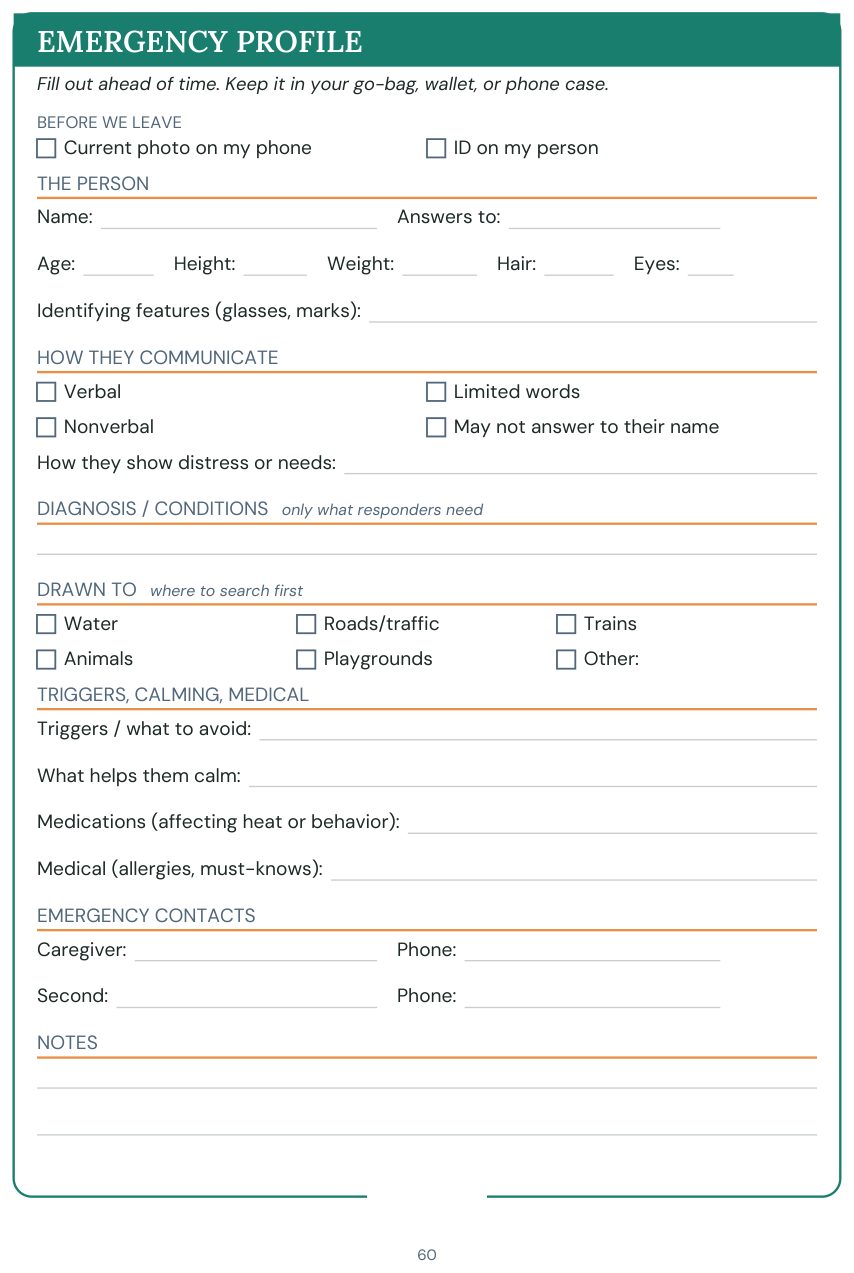
- Emergency Profile (keep all year)
- Trigger Profile / Caregiver Checklist (keep all year)
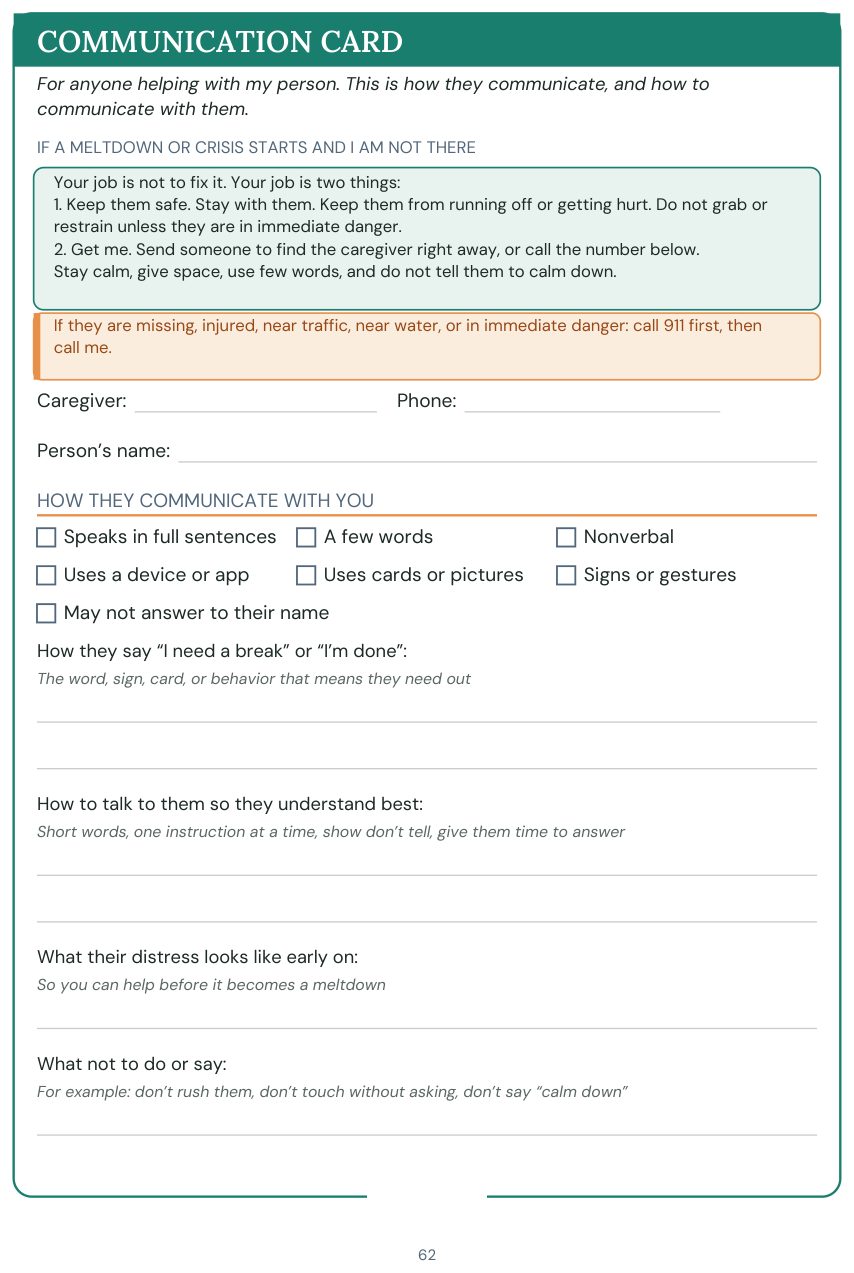
- Communication Card (keep all year)
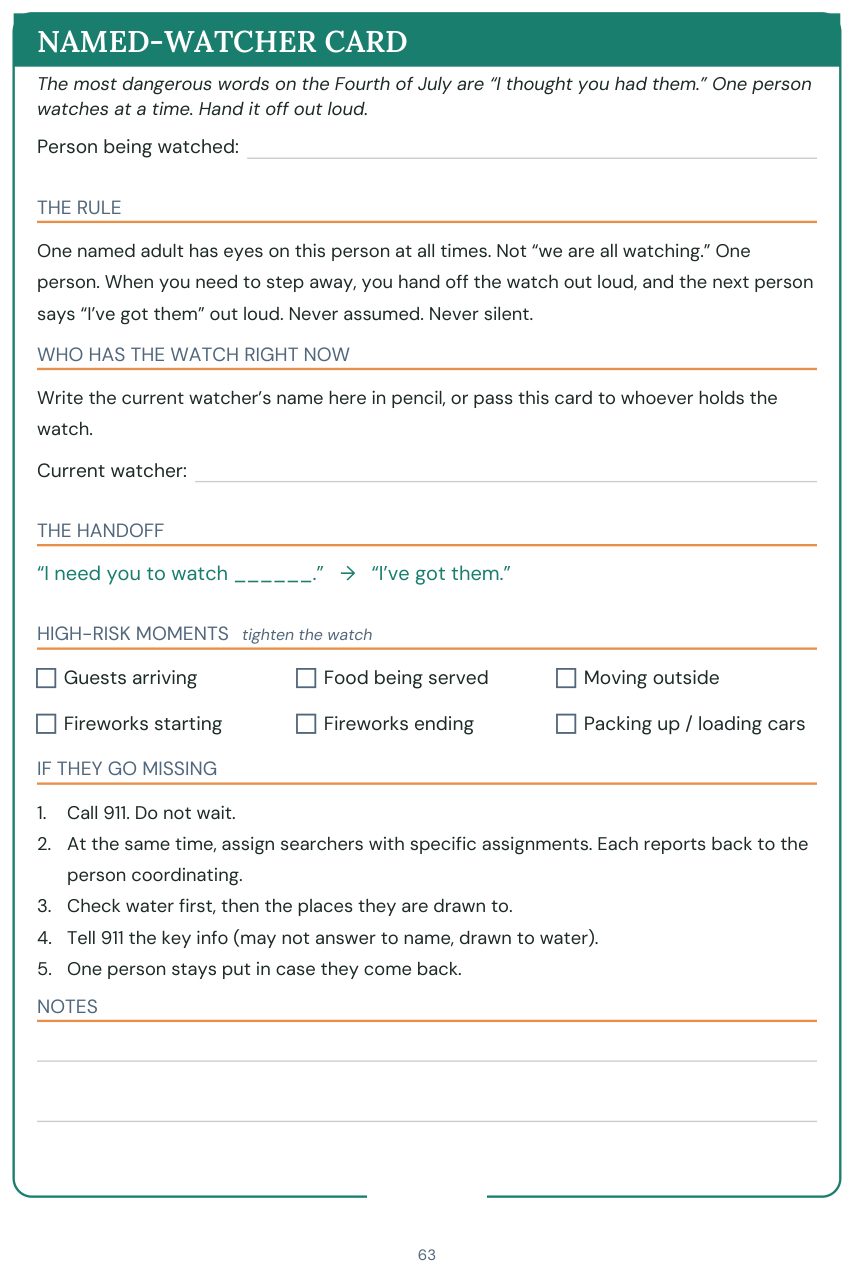
- Named-Watcher Card (keep all year)
- Go-Bag Checklist
- At-Home Plan
- Public-Event Plan
- Recovery Plan
These cards are designed to be printed. The previews below show what is in the set. Grab the PDF to print them on full-size pages and fill them out.
Chapter 20 · What Families Often Forget
You have the big things covered by now. This chapter is for the small ones, the easy-to-miss details that trip families up even when the main plan is solid.
Charge everything the night before. The communication device, the headphones, your phone. The one thing you forgot to charge is the thing you needed most at 9 p.m.
Bring backups of the small-but-critical stuff. A second pair of headphones if the first breaks. An extra comfort item if one gets lost. The favorite snack times two. The little things are the ones that cause the big problems when they go missing.
Tell people the plan before they're standing in your living room. The relatives, the host, the friends. If they hear "here's how she communicates and here's what helps" ahead of time, they're allies. If they're finding out mid-meltdown, they're in the way.
Watch the dog and the doors at the same time. On a day with guests coming and going, the pet bolting and the person bolting are both live risks, and they happen through the same open door.
Your person may not care about the holiday, and that's fine. They may not care about the barbecue, the flag, the fireworks, or the fun everyone else is having. A good day for them might look like the tablet in a quiet room. That is not a failure. That is them having the day on their terms.
Lower your own expectations on purpose. The Fourth of July may not be the day for the perfect family photo, the new food, or the milestone. Pick "everyone got through it okay" as the goal, and a lot of pressure comes off the whole day, including off you.
Clean up the debris. Spent fireworks, sparkler wire, and casings are sharp, hot, and toxic to pets and little kids. A quick sweep of the yard before anyone's back out there the next morning is worth it.
Take the picture of what they're wearing. Said elsewhere, repeated here because it's the one people skip. Before you leave, a quick photo of your person, head to shoes. If the worst happens, you have it instantly.
None of these are big. That's exactly why they get forgotten. Run through this list the night before, and you catch the small things before they become the day's problem.
Chapter 21 · Safety Contacts and Resources
This chapter is homework, the kind you do on a calm day so you are not scrambling on a hard one.
The whole guide comes down to one idea: plan ahead instead of reacting in the moment. Resources are part of that plan. The time to find the registry, ask the doctor, or save the crisis number is now, before the Fourth of July, while everyone is calm and nothing is wrong. Do the homework once, keep these where you can reach them, and they are already in hand when you actually need them.
Save these numbers in your phone now.
- 911. For any emergency. If your person is missing, injured, near water or traffic, or in immediate danger, call 911 first.
- 988 Suicide & Crisis Lifeline. Call or text 988 for a mental health crisis, yours or anyone's. Free, confidential, and available 24/7.
- Veterans Crisis Line. Dial 988, then press 1. You can also text 838255. For veterans, service members, and their families.
- Poison Help: 1-800-222-1222. Save this for possible poisoning. Medications, cleaning supplies, and household products can all become problems fast. Free, confidential, and available 24/7.
- ASPCA Animal Poison Control: 888-426-4435. Save this for animal poison emergencies. If a pet has ingested something poisonous, call right away. A consultation fee may apply.
- 211 (non-emergency). Save this for local, non-emergency help and community resources. It is the right number for "I need local help, but this is not an emergency."
Do this homework before the Fourth of July.
- Check your local wandering registry. Many sheriff's and police departments keep a voluntary registry where you give them your person's photo and information ahead of time, so responders already know who they are if they go missing. Call your local agency and ask, and set it up now, not during an emergency.
- Check whether your area uses Smart911 or a similar safety-profile system. Smart911 lets you build a free Safety Profile, your person's conditions, how they communicate, and more, that can come up automatically for a participating 911 center when you call. California runs a statewide version. Services vary by location, so set it up ahead of time and see what your area supports.
- Turn on emergency alerts now. Make sure Wireless Emergency Alerts are enabled on your phone, and sign up for your county or city's alert system if it has one. These warn you about wildfires, evacuations, and other dangers, which matters on a hot July day. Ready.gov explains the different alert systems, and California funds local alerts through Cal OES.
- Ask your person's doctor or pharmacist whether any medication affects heat, and what to watch for. A thirty-second question at a regular visit.
- Find out about hearing protection that fits your person, and get it before the day so you can practice with it.
- If your person has epilepsy, ask their neurologist before the Fourth of July whether flashing light is a trigger for them specifically.
- If your person has a serious allergy, make sure their epinephrine is current and on you, and that the people around you know how to use it.
- Talk to your vet ahead of time if your pet panics, about a calming aid, a wrap, or medication, and test anything new before the day.
Where to learn more.
This guide does not name every organization, because the right ones depend on your person and where you live. But a few good starting points exist for almost every topic in this book: national autism and disability organizations for elopement and safety planning, the Epilepsy Foundation for photosensitivity, the VA's National Center for PTSD for trauma, your local Regional Center or disability services for support near you, and your county IHSS office for the programs tied to your person's care. Your person's own doctors and team know your person best, and they are the right source for anything specific to them.
On wandering and elopement specifically: The National Autism Association runs the most established wandering-prevention program in the country. If your person is autistic, you may qualify to apply for their Big Red Safety Box, a free toolkit that includes door and window alarms, an ID bracelet or shoe tag, and caregiver and first-responder forms, one box per family while supplies last. Their wandering-prevention resources, including emergency-planning tools and first-responder profile forms, are worth reviewing on a calm day even if you do not apply for the box. Start at nationalautismassociation.org and look for the Big Red Safety Box.
This guide gives you the Fourth of July plan. Their materials go deeper on the year-round safety system. The two work well together.
When to get help.
Most of the Fourth of July, you handle yourself with a good plan. But some moments call for more, and there is no shame in any of them. If your person is missing or in danger, call 911. If anyone is in a mental health crisis, call or text 988. If you think someone has been poisoned, call Poison Help. And if a hard day is wearing you down past where you can carry it, reach out, to a friend, your own doctor, a crisis line, anyone. Taking care of yourself is part of taking care of your person.
The point of this chapter is simple: do the homework early. Make the calls, ask the questions, and save the numbers now, while it is calm. A resource you set up in advance is worth far more than one you go looking for in the middle of an emergency.
Printable Plans and Coloring Pages
These are designed to be printed. The two fill-in plans help your person take part in getting ready, and the coloring pages give a calm, quiet activity for the day. The previews below show what is in the set. Grab the PDF to print any of them.
Fill-in Plans
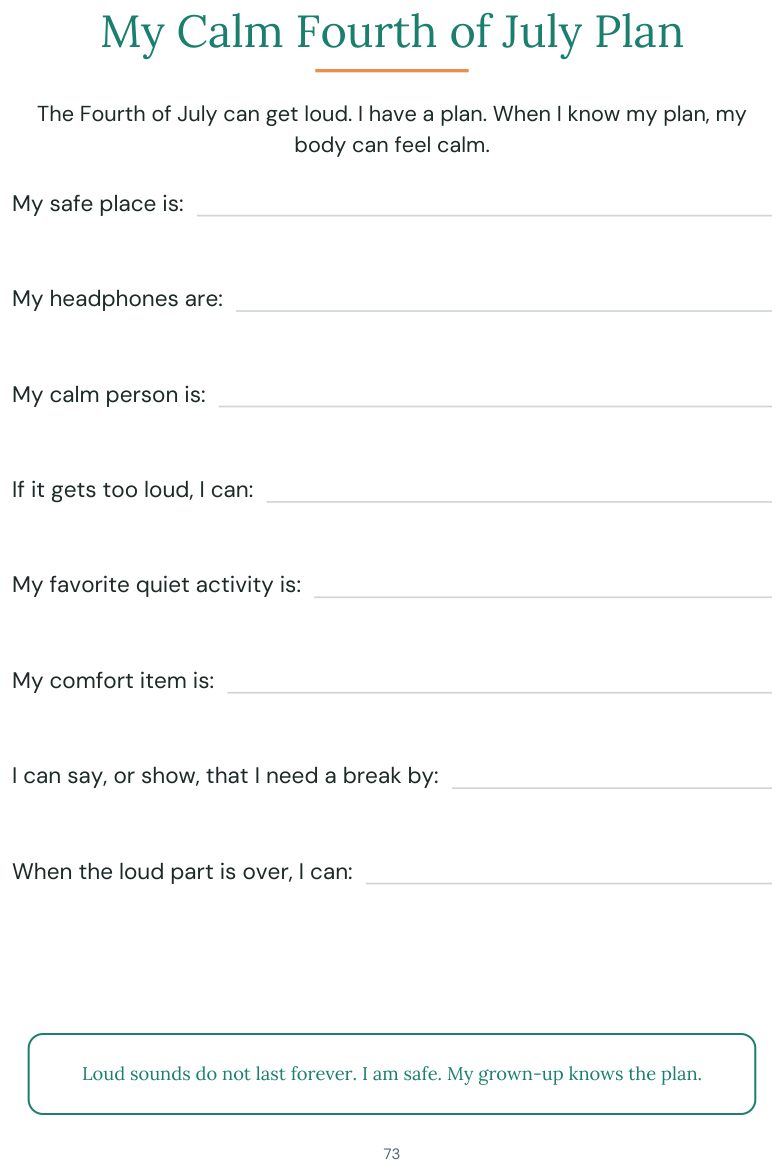
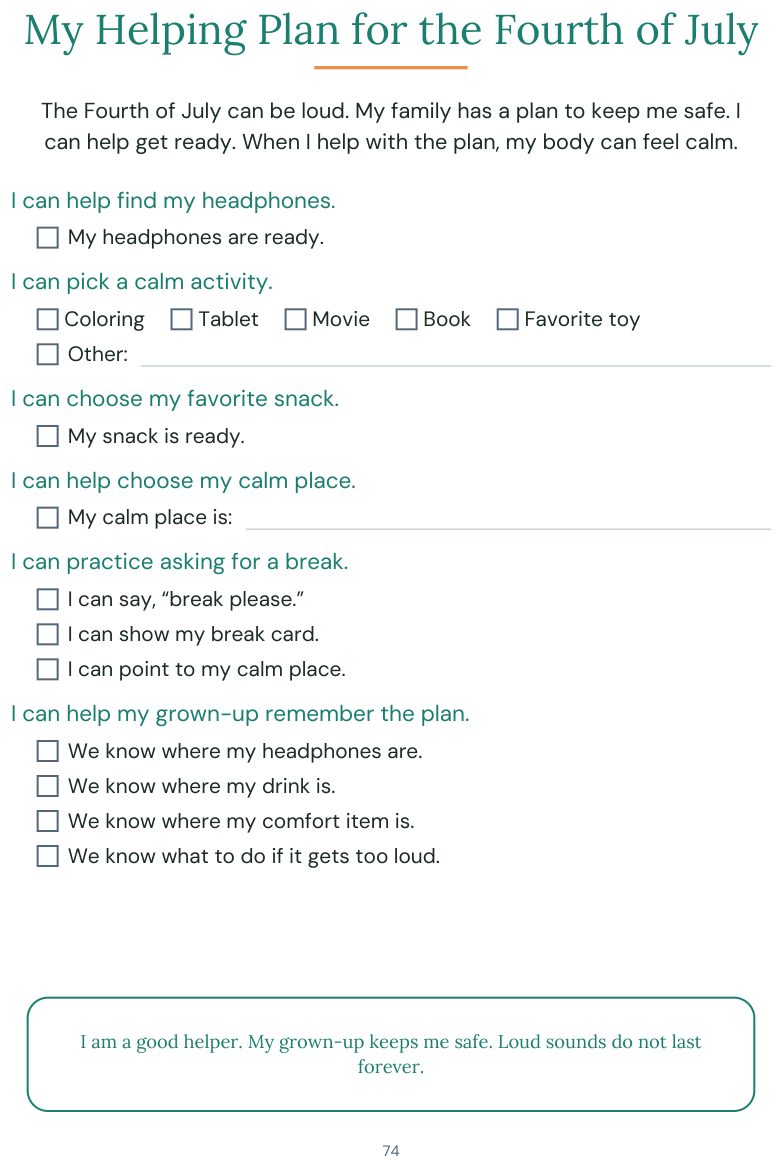
Coloring Pages
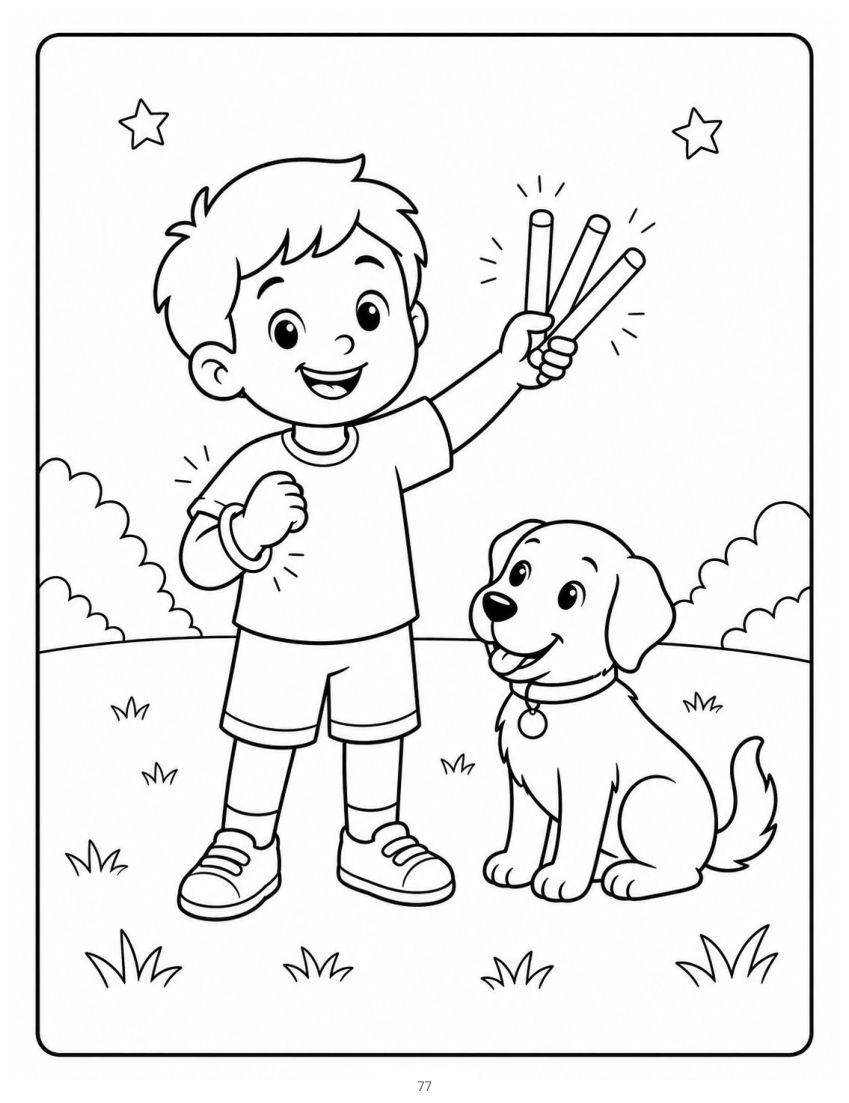
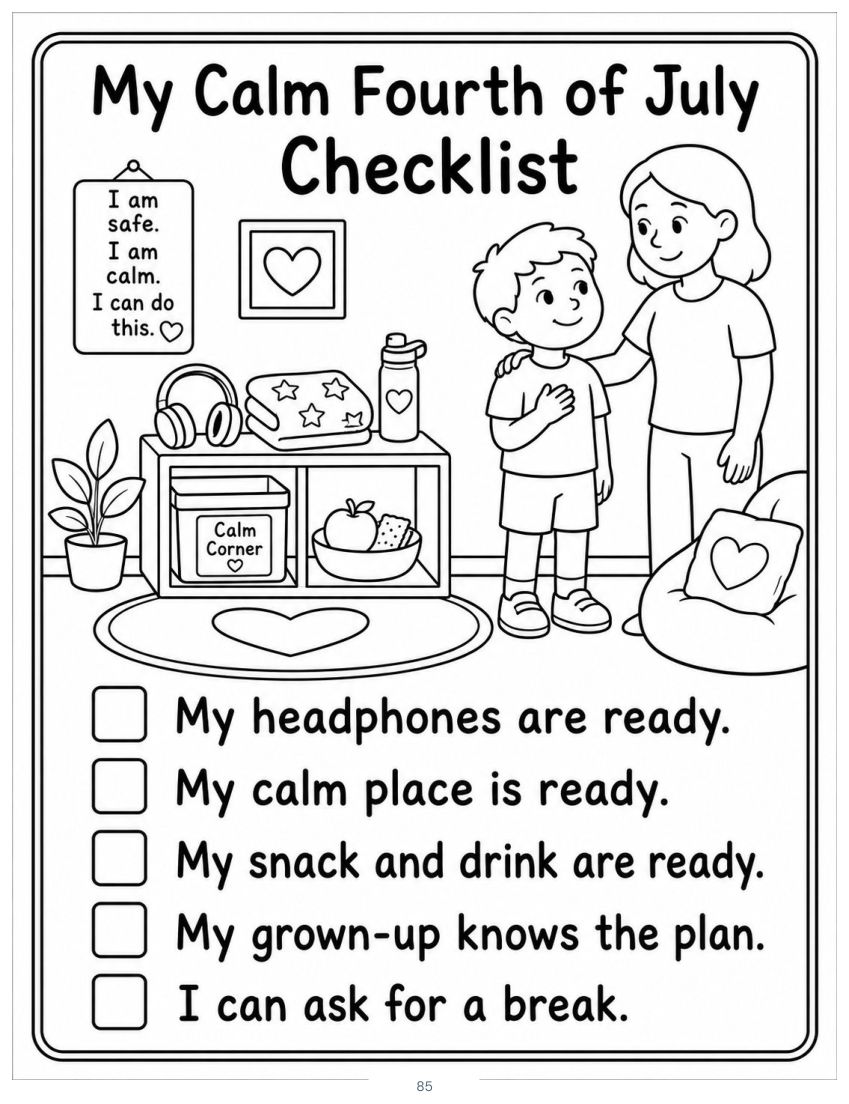

Sources
The facts and figures in this guide come from primary and authoritative sources. They are listed here by topic, with the specific claim each one supports, so you can verify anything yourself and read further.
Fireworks and sparklers
Sparklers burn at about 2,000 degrees Fahrenheit, hot enough to melt some metals, and were involved in an estimated 1,700 emergency-room-treated injuries in 2024. U.S. Consumer Product Safety Commission, Fireworks Safety, cpsc.gov.
Safe-and-sane fireworks classification and rules. California State Fire Marshal, osfm.fire.ca.gov.
Hearing and noise
Safe noise levels and impulse-noise hearing damage. National Institute on Deafness and Other Communication Disorders, nidcd.nih.gov, and the American Speech-Language-Hearing Association, asha.org.
Light, flashing, and seizures
Flashing at roughly 5 to 30 flashes per second is most likely to trigger seizures, and photosensitivity affects about 3 percent of people with epilepsy. Epilepsy Foundation, Photosensitivity and Seizures, epilepsy.com.
Sensory sensitivity to bright and flashing light in autism. Published autism sensory research.
Elopement and wandering
About 49 percent of children with autism attempt to elope from a safe place, far more often than their siblings. Anderson et al., 2012, Pediatrics (Kennedy Krieger Institute and the Interactive Autism Network).
Drowning is the leading cause of death in fatal wandering cases. Wandering-prevention resources include the Big Red Safety Box. National Autism Association, nationalautismassociation.org.
Heat, food, and medications
Perishable food should not sit out more than two hours, or one hour when it is hotter than 90 degrees Fahrenheit. U.S. Department of Agriculture, Food Safety and Inspection Service, fsis.usda.gov.
Medications that can impair the body's response to heat, including diuretics, anticholinergics, antipsychotics, antidepressants, beta-blockers, and stimulants. Centers for Disease Control and Prevention, Heat and Medications: Guidance for Clinicians, cdc.gov.
Smoke and air quality
Fireworks smoke and daily air quality. American Lung Association, lung.org, and U.S. EPA AirNow, airnow.gov.
Pets
Stray-pet intake at shelters rises in the days around the Fourth of July. Shelter Animals Count, shelteranimalscount.org, and the American Animal Hospital Association, aaha.org.
PTSD and trauma
Trauma, startle response, and veteran mental health. U.S. Department of Veterans Affairs, National Center for PTSD, ptsd.va.gov.
Crisis and safety contacts
988 Suicide and Crisis Lifeline; Veterans Crisis Line (988 then press 1, or text 838255); Poison Help (1-800-222-1222); ASPCA Animal Poison Control (888-426-4435); and Ready.gov and FEMA emergency alerts.
This guide is educational and does not replace medical, legal, veterinary, emergency, or professional advice. For anything specific to your person, follow their doctor, care team, pharmacist, veterinarian, or local emergency agency.
About IHSS Unlocked and Beyond IHSS
This guide is part of IHSS Unlocked's Beyond IHSS library, created to help families think through the real-life issues that do not always fit neatly inside a timesheet, benefit program, or county form.
IHSS Unlocked started as a tool to help California families plan their In-Home Supportive Services hours and get the most out of the program. But caring for a person with significant needs is bigger than any benefit. It is the loud days, the hard nights, the safety plans, and the small wins that nobody else sees. Beyond IHSS is where we cover those.
Buster is our emotional support dog. When the fireworks are too much for him, we are his emotional support humans. He is also my hiking buddy, the one who comes along when I need to get away to my favorite place and just be with nature.
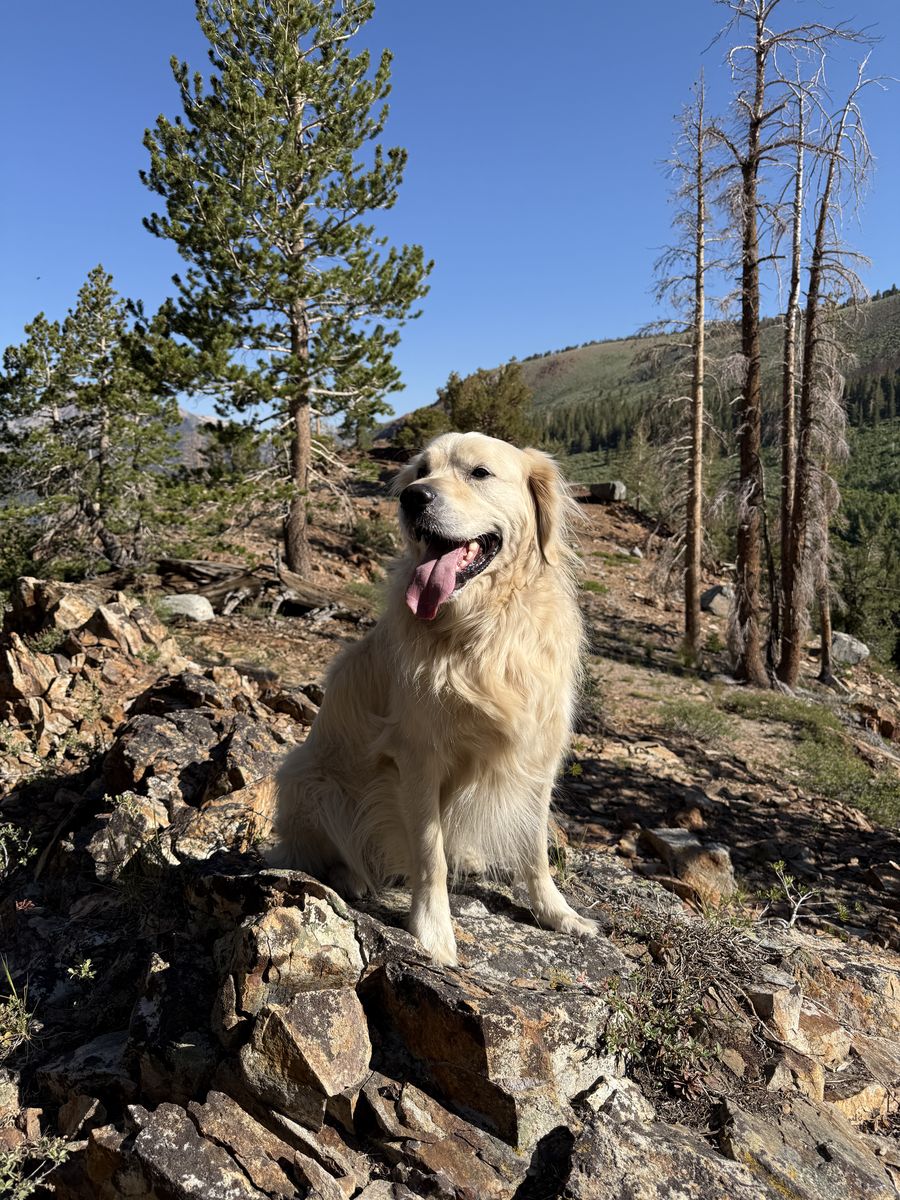
If this guide helped your family, that is the whole point. It is free, and it is meant to be shared. Pass it to another family who could use it.
If you are a California IHSS family and you have not yet looked at how your hours are planned, that is what IHSS Unlocked was built for. The planner helps you map your authorized hours across the pay period so you are not guessing, not scrambling at month's end, and not leaving care on the table. It is the same idea as this guide: plan ahead, on a calm day, so the hard days are easier. You can find it at ihssunlocked.com.